
Lesson 19 of 29 · Special places, people, vehicle, documents
Stopping and parking
9 min 31 questions
This lesson covers how stopping differs from parking and where a stopped vehicle has to be. Then come the places where stopping and parking are prohibited, and the distances worth remembering. It also covers where you may park for a long rest outside a populated area.
1 Stopping, parking and a forced stop
4 4 exam questions on this sectionStopping means intentionally halting a vehicle for up to 5 minutes. A longer halt is stopping too if passengers need to get in or out or the vehicle needs loading or unloading. A halt in traffic flow, at the demand of the technical means of organization of road traffic or a traffic controller, is not stopping. One example is waiting at a red traffic light.
Law: Art. 5 ¶11
Parking means intentionally halting a vehicle for more than 5 minutes when this is not needed for passengers to get in or out or for loading or unloading. If unloading a vehicle takes more than 5 minutes, it is still stopping, not parking.
Law: Art. 5 ¶20 ¶11
A forced stop is a halt caused by a technical fault of the vehicle, or by a danger. This danger may come from the load being carried, the condition of the driver (or a passenger), or an obstacle that suddenly appears on the road. A forced stop is defined by its cause, not by how long it lasts.
Law: Art. 5 ¶26
2 At the carriageway edge, usually on the right
As close to the edge as possible, on the right. When stopping or parking on the carriageway, a vehicle must be as close as possible to its edge. The driver may stop or park the vehicle on the right side of the carriageway.
Law: Art. 37 ¶2
On the left: in three cases only. A vehicle may use the left side of the carriageway for stopping and parking in three cases only. First, if rail tracks make it impossible to stop on the right. Second, in a populated area on a road with one lane in each direction and no tram tracks in the middle. Third, on the carriageway of a one-way road (a truck may stop on the left of such a road only while it is being loaded or unloaded).
Law: Art. 37 ¶2 ¶2(a) ¶2(b) ¶2(c)
A truck on the left of a one-way road: only for loading or unloading. Stopping on the left side of a one-way road is allowed for a truck only while it is being loaded or unloaded. That limit does not apply to a passenger car: it may use the left side there for both stopping and parking.
Law: Art. 37 ¶2(c)
You are driving through a populated area on a two-way road with two lanes in each direction, and a passenger is waiting on the left side. Stopping at the left edge is not allowed here: there are no rails on the right, there is more than one lane each way, and the road is not one-way.
In the middle: only where a sign or marking allows. A vehicle may use the middle of the carriageway for stopping and parking only in places set by the matching road sign or road marking.
Law: Art. 37 ¶3
Outside a populated area: off the carriageway. A populated area ends, for example, at sign 5.24.1 or 5.26. Beyond it, a stopping or parked vehicle must be off the carriageway as far as possible, for example on the shoulder. Stopping or parking at the edge of the carriageway is correct there only if stopping off it is not possible.
Law: Art. 37 ¶1 Art. 5 ¶15 Art. 31 ¶18 Annex 1, sign 5.24.1 Annex 1, sign 5.26
Outside a populated area, two people are waiting for you by the road, and there is a wide shoulder next to the carriageway. To pick them up, you stop on the shoulder, not at the edge of the carriageway or in its middle.
3 One row, and the sidewalk edge
In one row, parallel to the edge. Vehicles may be parked in one row, parallel to the edge of the carriageway, except where the place allows a different arrangement. Two-wheeled vehicles without a sidecar, that is without a side trailer, may use two rows for parking. A motorcycle with a sidecar is not one of them, so it must not be parked in a second row.
Law: Art. 37 ¶4
Who may park on the sidewalk edge. Only passenger cars, motorcycles, mopeds and bicycles may use the edge of a sidewalk next to the carriageway for parking, and only if they do not obstruct pedestrians. Any truck, even a small one, must not park on the sidewalk edge. The English exam questions often call a truck a lorry.
Law: Art. 37 ¶4
4 Where stopping is prohibited
On a crossing and closer than 5 m before it. On the carriageway, stopping a vehicle is prohibited on pedestrian crossings and cyclist crossings, and closer than 5 m before them. Right after a crossing, this ban does not apply.
Law: Art. 37 ¶6 ¶6(a) ¶6(a.a)
On an intersection and closer than 5 m to its edges. Stopping is prohibited where carriageways cross, and closer than 5 m from the edges of that crossing, both before the intersection and after it. The exception is a three-way intersection with a solid marking line or a dividing strip: there, vehicles may stop only opposite the side exit. Without such a line or strip, stopping opposite the side exit is prohibited too.
Law: Art. 37 ¶6 ¶6(a) ¶6(a.c)
A pedestrian crossing often lies right at an intersection. Then the spot just after the crossing may still be closer than 5 m to the edge of the crossing carriageways, and stopping there is prohibited. Stopping is allowed before the crossing, more than 5 m from it.
Tram and railway tracks. On the carriageway, stopping is prohibited on tram and railway tracks laid within the road, or near them, if this may hinder trams or trains.
Law: Art. 37 ¶6(a) ¶6(a.b)
A lane for route vehicles. A lane intended for the movement of route vehicles is a lane where stopping and parking are prohibited for other vehicles. The law makes exceptions only for a few cases, for example taxis admitted by the municipality. Route vehicles themselves stop in that lane, for example to let passengers on and off.
Law: Art. 37 ¶1 Art. 41 ¶3
5 Bridges, tunnels and other risky places
Where a stop may create danger. Stopping is prohibited anywhere a vehicle may create danger. For example, on the carriageway near a dangerous bend or a convex break in the road’s long profile, where visibility in at least one direction is under 100 m. Or where it hides traffic light signals or road signs from other road users. Stopping is also prohibited on an additional lane for slow-moving vehicles marked with a sign.
On a bridge: only with more than two lanes your way. Stopping is prohibited on viaducts, bridges and overpasses, except where there are more than two lanes in the same direction. The ban applies even if you only need to pick up a passenger.
Law: Art. 37 ¶6(b) ¶6(b.a)
A bridge has three lanes your way and two the other way. You stop at the right edge to pick up a passenger: this is allowed. A driver coming the other way is prohibited from stopping on this bridge: that direction has only two lanes.
Under a bridge or in a tunnel: only in designated places. Stopping is prohibited under viaducts, bridges and overpasses, and in tunnels. The exception is a place specially set aside for it, for example a car park under an overpass.
Law: Art. 37 ¶6(b) ¶6(b.b)
At least 3 m from a solid line. Stopping is prohibited where the distance between a solid marking line and the stopped vehicle is less than 3 m. The line marking the edge of the carriageway does not count here. On a narrow road with a solid line in the middle, the distance may be under 3 m even right at the edge of the carriageway.
Law: Art. 37 ¶6(b) ¶6(b.d)
Closer than 15 m to a route-vehicle stop. Stopping a vehicle is prohibited closer than 15 m to a structurally designated stopping place of route vehicles or taxis, if this hinders those vehicles. Where there is no such place, the distance is counted from the stop indicator of route vehicles or taxis.
Law: Art. 37 ¶6(b) ¶6(b.g)
6 Where parking is prohibited
The zone of a prohibiting sign or marking. Stopping is prohibited in the zone of a sign or marking that prohibits stopping, and parking in the zone of a sign or marking that prohibits parking. Examples are signs 3.27 and 3.28 and the yellow marking lines 1.4 and 1.10. Parking is also prohibited against the parking method set by a sign or marking. More on this in the lessons on prohibitory signs and road markings.
Law: Art. 37 ¶6(c) ¶7(g) ¶7(h) ¶7(i) Annex 1, sign 3.27 Annex 1, sign 3.28 Annex 2, marking 1.4 Annex 2, marking 1.10
Where stopping is banned, plus near railway crossings and yard exits. Parking is prohibited wherever stopping is prohibited. It is also prohibited on the carriageway closer than 50 m to a railway crossing, and where a motor vehicle exits a yard.
Law: Art. 37 ¶7 ¶7(a) ¶7(b) ¶7(d)
Where high speed is allowed. Outside a populated area, parking is prohibited on a carriageway marked with sign 2.1, 5.1 or 5.3. In a populated area, it is prohibited on a carriageway where traffic may go faster than 80 km/h. In both cases, specially marked places are the exception. In a populated area, signs 2.1, 5.1 or 5.3 are not needed for this: a permitted speed above 80 km/h is enough to ban parking on the carriageway.
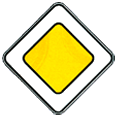 2.1 · Main Road
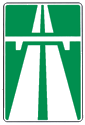 5.1 · Motorway
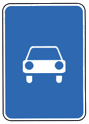 5.3 · Expressway
Law: Art. 37 ¶7(f) Annex 1, sign 2.1 Annex 1, sign 5.1 Annex 1, sign 5.3
A long rest: only at a designated area or off the road. Outside a populated area, you may park for a long rest (overnight or otherwise) only at a designated parking area, or beyond the road. The shoulder is part of the road, so it will not do for such a rest.
Law: Art. 37 ¶11 Art. 5 ¶12
Outside a populated area, you are tired and want to spend the night in the car. A sign shows a rest area ahead. No driver may park on the shoulder for such a rest, so you drive on to the rest area or leave the road altogether.
The middle of three lanes. If the middle lane of a three-lane road is used in both directions, you may enter it only for overtaking, going around an obstacle, turning left or a U-turn. More on this in the lesson on vehicle position on the road.
Law: Art. 31 ¶7
Key points
- Stopping is up to 5 minutes, or longer for passengers or loads; parking is over 5 minutes when it is not needed for them. A forced stop is defined by its cause: a fault or a danger.
- On the carriageway, keep as close to the edge as possible, on the right. On the left only in three cases, and a truck on a one-way road only for loading or unloading. Outside a populated area, off the carriageway where possible.
- Park in one row, parallel to the edge; only two-wheelers without a side trailer, or sidecar, may use two rows. On the sidewalk edge, only passenger cars, motorcycles, mopeds and bicycles, if they do not obstruct pedestrians.
- Stopping is prohibited on a crossing and closer than 5 m before it, and on an intersection and closer than 5 m to its edges. It is also prohibited under 3 m from a solid line, and within 15 m of a stop of route vehicles or taxis if this hinders them. On a bridge, unless there are more than two lanes your way; under a bridge or in a tunnel, except in designated places.
- Parking is prohibited wherever stopping is, and also on the carriageway closer than 50 m to a railway crossing and where a motor vehicle exits a yard. Parking for a long rest outside a populated area only at a designated area or beyond the road. In a populated area, parking is prohibited on a carriageway where more than 80 km/h is allowed, except in specially marked places.
Plain-language summary for exam preparation; the law's text prevails.
Now answer this lesson's questions
31 exam questions are about this lesson. A wrong answer comes back until you get it right, and you see which questions are ready for the exam.
Practise the questionsFree account · sign in with e-mail or Google
The law behind this lesson
31 exam questions
Practise the questions