
Lesson 18 of 29 · Moving on the road
Intersections and giving way
8 min 45 questions
At an intersection with no traffic light and no traffic controller, drivers work out the order themselves, from the priority signs and the rules of the law. This lesson covers who gives way to whom where equal roads cross, where a main road meets a secondary one, and where the main road changes direction. It also covers when a tram has priority, and when you may not enter an intersection even on green.
An intersection also counts as unregulated when its traffic light shows a flashing yellow signal or is not working. The order there is then set by the priority signs and the rules of this lesson. More on this in the lesson on traffic lights.
Law: Art. 36 ¶2
1 Intersections and priority
4 4 exam questions on this sectionAn intersection is a crossing, joining or branching of roads at the same level, including the areas such crossings, joinings or branchings form. Where an exit from an adjacent territory meets a road, that is not an intersection. An adjacent territory lies right next to a road and is not meant for through traffic of vehicles. Examples are a yard, a residential complex, a car park, a filling station or an institution.
Law: Art. 5 ¶13 ¶38
Priority is the right of a road user to move first on the road in the intended direction, compared with other road users. Giving way (not creating an obstacle) is the reverse: not a right but an obligation. Whoever gives way does not continue or resume moving, or make a maneuver, if that would force a road user with priority to change direction or speed suddenly.
Law: Art. 5 ¶84 ¶14
2 Equal roads
36 36 exam questions on this sectionRoads are equal when neither is the main road compared with the other. There are no priority signs and no signs 1.7.1–1.7.7 at the intersection, and both roads have the same class of surface: both hard-surfaced, both gravel or both dirt. Sign 1.6, Intersection of Roads of Equal Importance, may stand before such an intersection.
Law: Art. 5 ¶37 Annex 1, sign 1.6
Give way to traffic from the right. Where equal roads cross, the driver of a trackless vehicle must give way to vehicles approaching from the right. Drivers of rail vehicles must follow the same rule among themselves.
Law: Art. 36 ¶4(c)
The tram’s priority. Where equal roads cross, a rail vehicle has priority over trackless vehicles, whichever way it is going. A tram goes before trackless vehicles even when it comes from the left or turns left.
Law: Art. 36 ¶4(c)
Turning left and U-turns. When turning left or making a U-turn, the driver of a trackless vehicle must give way to oncoming vehicles on an equal road. This covers oncoming vehicles going straight on or turning right. Drivers of rail vehicles must follow the same rule among themselves.
Law: Art. 36 ¶4(d)
In the diagram, the tram turns left while a car comes the other way going straight on. The tram goes first: on equal roads it has priority over trackless vehicles, even when turning left. The car on the right of the oncoming car goes second, and the oncoming car, giving way to both, goes last.
Sometimes, on equal roads, each of three drivers has someone to give way to. Say one driver turns left while another comes the other way going straight on. A further driver approaches from the oncoming driver’s right and has the left-turning driver on their own right. Then the left-turning driver enters the intersection first and stops without crossing the oncoming driver’s path. Next the driver on the oncoming driver’s right goes, then the oncoming driver, and the left turn is finished last.
Law: Art. 36 ¶4(c) ¶4(d)
3 Main and secondary roads
3 3 exam questions on this sectionA main road is a road marked with sign 2.1, Main Road, or 5.1, Motorway, along the whole section where that sign applies. At an intersection, a road marked with signs 1.7.1–1.7.7 also counts as the main road compared with the road crossing or joining it. Signs 2.3, Yield (Give Way), and 2.4 stand before the intersection on the secondary road: drivers on it give way.
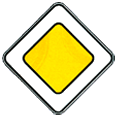 2.1 · Main Road
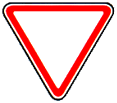 2.3 · Yield (Give Way)
 2.4 · No Entry Without Stopping
Law: Art. 5 ¶37 Annex 1, sign 2.1 Annex 1, sign 2.3 Annex 1, sign 2.4
A hard-surfaced road (asphalt, cement concrete, a similar material or cobblestones) also counts as the main road compared with a gravel or dirt road. A gravel road is the main road compared with a dirt road. A hard-surfaced stretch on a gravel or dirt road right before the intersection does not make it equal to a hard-surfaced road. The English exam questions sometimes call a dirt road a ground road.
Law: Art. 5 ¶37
Secondary gives way to main. Where unequal roads cross, the driver of a vehicle on the secondary road must give way to vehicles approaching on the main road, whatever direction they then take. The main road keeps its priority even when the driver on the secondary road approaches from the right. Giving way to the right applies only between drivers who are equal to each other.
Law: Art. 36 ¶4(a)
A tram on a secondary road gives way too. This covers trams too: at an unregulated intersection, the law gives a rail vehicle priority only where equal roads cross. If the tram is on a secondary road crossing the main road, its driver must give way to vehicles on the main road, whichever way they go. The same holds when the tram approaches them from the right.
Law: Art. 36 ¶4(a) ¶4(c)
Say the main road runs straight on, and secondary roads with the same class of surface join it from both sides. Neither of them is then the main road compared with the other. Drivers on them have no priority over each other and go as on equal roads. A driver of a trackless vehicle turning left or making a U-turn lets through an oncoming vehicle on the same road that goes straight on or right. This holds on the main road and on a secondary road alike.
Law: Art. 5 ¶37 Art. 36 ¶4(d)
Coming off a dirt road. Unless a road sign provides otherwise, a driver coming off a dirt road onto a road that is not one must give way to vehicles moving along it. An animal-drawn cart is a vehicle too, and its drover counts as a driver. So the driver must also give way to a drover’s cart on that road.
Law: Art. 36 ¶6 Art. 5 ¶49 ¶73
You come off a dirt road onto a hard-surfaced road and turn left. Opposite you, another driver comes off a second dirt road and goes straight on. You both give way to the vehicles on the hard-surfaced road, a drover’s cart included. The two dirt roads are equal to each other, so as you turn left you also give way to the oncoming driver.
When the surface cannot be seen. Sometimes a driver cannot tell whether the road has a surface, because of darkness, snow, mud or another reason. If there are also no priority signs, the driver is considered to be on a secondary road.
Law: Art. 36 ¶8
Snow covers the intersection: you can see neither the surface nor any priority sign. Then you count as being on a secondary road, and so does the driver on the crossing road. Neither of you has priority over the other: whoever has the other approaching from the right gives way.
4 When the main road turns
Sometimes the main road changes direction at an intersection. Then plate 8.13, Direction of Main Road, is placed with signs 2.1, 2.3 and 2.4. It draws the intersection as the driver in front of the sign sees it: the wide line is the main road, the narrow ones are secondary roads. The driver’s own road is the line that starts at the bottom edge of the plate. More on this in the lesson on priority signs.
 8.13 · Direction of Main Road
Law: Annex 1, sign 8.13
Among themselves, as on equal roads. If the main road changes direction at the intersection, drivers moving along it must follow the rules for equal roads among themselves. Drivers moving along the secondary roads must follow the same rules among themselves.
Law: Art. 36 ¶4(b)
In the diagram, the main road comes up from the bottom and turns left. The car from the bottom turns left and stays on the main road; the car from the left goes straight on and leaves it for a secondary road. Neither has priority over the other, so the car from the left gives way to the one approaching from its right. The tram from the top is on a secondary road, so it gives way to both.
At an unregulated intersection, the rule on giving way to oncoming traffic when turning left covers only an oncoming vehicle on a road equal to the driver’s own. So the car from the bottom does not give way to the tram coming the other way. The tram is on a secondary road, and it is the tram that gives way.
Law: Art. 36 ¶4(d) ¶4(a)
5 Jams and service vehicles
2 2 exam questions on this sectionA jam beyond the intersection. A driver must not enter an intersection if there is a jam that would likely force the driver to stop in it and so obstruct crossing traffic. This rule applies even when the traffic light signals let traffic go.
Law: Art. 36 ¶5
The traffic light in front of you is green. Just past the intersection, straight ahead, a line of cars has stopped, while the road to the right is clear. If you go straight on, you would stop in the middle of the intersection and block crossing traffic, so you may not enter. A driver turning right will clear the intersection, and the ban does not apply to them.
At an intersection the service vehicle goes first. At an intersection, other drivers must give way to a vehicle with the blue light and sound signal on, and to the vehicle it escorts with dipped beams. This holds whichever road they are on, even when their traffic light is green. These vehicles cross the intersection first; after them, the others go among themselves by the usual intersection rules.
Law: Art. 51 ¶2 ¶1
If the blue light is off, or on without the sound signal, such a vehicle has no priority over other road users. On a secondary road, they give way like any other driver.
Law: Art. 51 ¶1 ¶2 Art. 36 ¶4(a)
Key points
- On equal roads you give way to the vehicle approaching from the right, and when turning left or making a U-turn, to an oncoming vehicle going straight on or right. At such an intersection a tram goes before trackless vehicles, whichever way it is going.
- From a secondary road you give way to everyone approaching on the main road, whichever way they go. A tram on a secondary road gives way too.
- When the main road turns, drivers on it go by the equal-road rules among themselves, and so do drivers on the secondary roads. At an unregulated intersection, a driver on the main road does not give way to an oncoming vehicle on a secondary road.
- Coming off a dirt road onto one that is not, you give way to the traffic on it unless a sign provides otherwise. If you cannot see the surface and there are no priority signs, you are considered to be on a secondary road.
- You may not enter an intersection if a jam would make you stop in it and block crossing traffic, even on green. A service vehicle with the blue light and sound signal on goes through first.
Plain-language summary for exam preparation; the law's text prevails.
Now answer this lesson's questions
45 exam questions are about this lesson. A wrong answer comes back until you get it right, and you see which questions are ready for the exam.
Practise the questionsFree account · sign in with e-mail or Google
The law behind this lesson
45 exam questions
Practise the questions