
Lesson 20 of 29 · Special places, people, vehicle, documents
Railway crossings and trams
6 min 13 questions
At a railway crossing, where the track crosses the road, the driver must give way to the train. This lesson covers when you must not enter a crossing and where to stop before it when movement over it is prohibited. It also covers what to do after a forced stop on a crossing and how to give the general alarm signal.
1 What a railway crossing is and how to cross it
1 1 exam question on this sectionOnly a crossing on one level. A railway crossing is a crossing, on one level, of a road and a railway or tramway track with an independent roadbed. The road and the rails are at the same height, and vehicles drive straight across the tracks. Where the road passes over or under the tracks, on a bridge or through a tunnel, the crossing is on different levels and is not a railway crossing. The English exam questions often call a railway crossing a railroad crossing.
Law: Art. 5 ¶58
So this lesson’s rules also apply where tram tracks with an independent roadbed cross the road on one level. Signs 1.1 (Railway Crossing with Barrier) and 1.2 (Railway Crossing without Barrier) warn of an approaching crossing. More on this in the lessons on warning signs, on vehicle position on the road and on intersections.
Law: Art. 5 ¶58 Annex 1, sign 1.1 Annex 1, sign 1.2
Moderate speed, no stopping. All road users must take particular care when approaching a railway crossing and while crossing it. A vehicle’s driver must drive at a moderate speed and cross without stopping. To cross a railway track, the driver must use only a railway crossing and must give way to the train (locomotive, draisine).
Law: Art. 39 ¶1 ¶1(a) ¶1(f)
2 When entering is banned
Barrier closed, closing or rising. Whatever the light and sound signals show, road users must not enter a railway crossing whose barrier or half-barrier is closed, closing or rising. Opening a barrier or half-barrier on one’s own authority is prohibited. Driving around a closed half-barrier is prohibited too: it is still entering the crossing. The English exam questions often call a half-barrier a semi-barrier.
Law: Art. 39 ¶1(b) ¶2 ¶2(b)
A prohibiting signal, whatever the barrier. On a prohibiting signal of a traffic controller or a traffic light, road users must not enter a railway crossing. It makes no difference whether the barrier or half-barrier is up or down, or whether there is one at all. Railway crossings use a special traffic light ტ.6 დამ.. On red of such a traffic light, crossing the stop line is prohibited, and where there is none, passing the light.
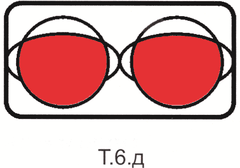 ტ.6 დამ. · T.6 extra
Law: Art. 39 ¶1(c) Art. 29 ¶8
How a traffic controller closes a crossing. At a railway crossing a traffic controller closes the way for a driver by facing the driver chest-on or back-on. The controller also either raises a baton, a red lantern or a flag above the head, or stretches the arms out to the sides.
Law: Art. 39 ¶4
A crossing with no barrier or lights. Some railway crossings have no barriers, half-barriers or light signals. Road users must not cross such a crossing until they have made sure that no rail vehicle is approaching it within sight.
Law: Art. 39 ¶1(d)
Enter only if there will be no stopping on it. A driver must not enter a railway crossing without first making sure that they will not be forced to stop on it.
Law: Art. 39 ¶1(e)
The barrier is up and no signal bans moving, but traffic is jammed just past the railway crossing. If there is no room for your car beyond the tracks, do not drive onto the crossing: it would mean stopping on it. Wait before the crossing until there is room beyond it.
3 The stopping place before a crossing
Stop line, sign or light first. If movement over a railway crossing is prohibited, the driver must stop at the stop line, at sign 2.4 (No Entry Without Stopping) or at the traffic light. Where there is a stop line, the driver stops at it, even if the sign or the traffic light stands further on; where there is none, before the sign. Where there are none of them, the driver must stop no closer than 5 metres to the barrier or half-barrier. If there is neither a barrier nor a half-barrier, the driver must stop no closer than 10 metres to the nearest rail.
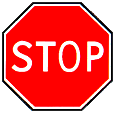 2.4 · No Entry Without Stopping
Law: Art. 39 ¶3 Annex 1, sign 2.4 Annex 2, marking 1.12
You approach a railway crossing where the half-barrier is closed: entry is banned, whatever the traffic light beside it shows. There is no stop line or sign 2.4, so the stopping place is the traffic light, not 5 metres before the half-barrier. At another crossing the half-barrier is closed too, but there is no stop line, no sign 2.4 and no traffic light. There the stopping place is no closer than 5 metres to the half-barrier.
4 Other bans at a crossing
Going around via the oncoming lane, moving machinery. At a railway crossing it is prohibited to go around vehicles standing before it by moving into the oncoming lane. It is prohibited to move agricultural, road-construction and other machines and mechanisms in non-transport condition that could damage the crossing or hinder traffic over it.
Law: Art. 39 ¶2 ¶2(a) ¶2(c)
Overtaking is prohibited on a railway crossing and less than 100 metres before it. The exception is a crossing where traffic is regulated by a traffic light of the type used at intersections. This ban does not apply to overtaking two-wheeled bicycles, mopeds and motorcycles without a sidecar. U-turns and reversing on a railway crossing are prohibited too. More on this in the lessons on overtaking and on turns and U-turns.
5 A forced stop on a crossing
First, get the vehicle off the track. After a forced stop of a vehicle on a railway crossing, the driver must try to get it off the railway track. If that is impossible, the driver must warn the rail vehicle’s driver of the danger in good time and at once take every safety measure in their power.
Law: Art. 39 ¶5
Get passengers out, warn the train. If the vehicle cannot be moved off the track, the driver must get the passengers out at once. If possible, the driver must send two people 1000 metres along the tracks, one each way, and explain to them how to signal the train driver to stop. If only one person is sent, it is towards the side where the track is harder to see. The driver must stay near the vehicle giving the general alarm signal, and run towards the train when it appears, giving the signal for stopping.
Law: Art. 39 ¶5(a) ¶5(b) ¶5(c) ¶5(d)
The stop signal and the general alarm. The signal for stopping is a circular movement of the arm. By day it is made with a piece of brightly coloured cloth or some other clearly visible object, by night with a torch or a lantern. The general alarm signal is one long and three short sound signals: only one of the four is long. The English exam questions often call it the common alarm honk.
Law: Art. 39 ¶6
Key points
- A railway crossing is a crossing, on one level, of a road and a railway or tramway track with an independent roadbed. A crossing on different levels, on a bridge or through a tunnel, is not a railway crossing.
- Do not enter a railway crossing whose barrier or half-barrier is closed, closing or rising, or on a prohibiting signal of a traffic controller or light, whatever the barrier. A driver must not enter unless sure of not being forced to stop on it.
- If movement over the crossing is prohibited, stop at the stop line or, without one, before sign 2.4 or at the traffic light. Without any of them, stop no closer than 5 metres to the barrier or half-barrier. With neither a barrier nor a half-barrier, stop no closer than 10 metres to the nearest rail.
- At a crossing it is prohibited to open the barrier or half-barrier on one’s own authority or to go around vehicles standing before the crossing through the oncoming lane.
- After a forced stop on a crossing, try to get your vehicle off the track. If that cannot be done, get the passengers out and give the general alarm signal: one long and three short sound signals.
Plain-language summary for exam preparation; the law's text prevails.
Now answer this lesson's questions
13 exam questions are about this lesson. A wrong answer comes back until you get it right, and you see which questions are ready for the exam.
Practise the questionsFree account · sign in with e-mail or Google
The law behind this lesson
13 exam questions
Practise the questions