
Lesson 16 of 29 · Moving on the road
Speed and distance
11 min 45 questions
This lesson covers how to choose your speed for the road conditions, and the speed limits the law sets in and outside populated areas and for different categories of vehicles. It also covers the distance a vehicle needs before stopping completely, and the distance to keep to avoid a collision.
Most of the rules here come from one article of the Law of Georgia on Road Traffic, on speed and distance. The last section covers braking, bends and skids: apart from the ban on sharp braking, the law does not regulate this, but a driver needs to know it.
Law: Art. 33
1 Speed to suit the conditions
22 22 exam questions on this sectionWithin the limit and in control. A driver must not drive a vehicle faster than the speed limits set by the law. The speed the driver chooses must allow constant control of the vehicle, so that traffic stays safe.
Law: Art. 33 ¶1
Take the road conditions into account. While driving, the driver must take the road conditions into account. They include the terrain, the state of the road and of the vehicle, its load, the weather, the traffic density, insufficient or restricted visibility and so on. This is so that, when needed and before any danger or obstacle, the driver has time to take every possible safety measure: slow down and, if necessary, stop.
Law: Art. 33 ¶2
Not too slow either. Without a special reason, a driver must not hold up other vehicles by driving excessively slowly. So exceeding the maximum speed is not the only thing prohibited: holding up other vehicles by driving far too slowly without a special reason is a violation too.
Law: Art. 33 ¶3
2 Speed limits: where and for whom
60 km/h in a populated area. Unless the law says otherwise, vehicles in a populated area may drive at no more than 60 km/h, and in a residential zone at no more than 20 km/h. Where road conditions allow a higher speed, a road sign may raise it on some sections of road. The English exam questions often call a populated area an inhabited area.
Law: Art. 33 ¶6
Limits that apply everywhere. Unless the law says otherwise, in and outside populated areas, vehicles of categories T and S may drive at no more than 40 km/h on all roads. A vehicle of category AM may drive on the carriageway at no more than 45 km/h. A mechanical vehicle towing another mechanical vehicle may drive at no more than 50 km/h. So when towing another mechanical vehicle, the limit in a populated area is 50 km/h too, not 60 km/h.
Law: Art. 33 ¶8 ¶8(a) ¶8(b) ¶8(d) ¶6
You are towing another car on a rigid bar and catch up with a tractor. You can overtake it only at no more than 50 km/h: overtaking gives no right to exceed your own limit. And a tractor may do no more than 40 km/h even on an empty road outside a populated area.
Unless the law says otherwise, outside populated areas the limit depends on the category of the vehicle and on whether the road is a motorway. The same limits apply in a populated area on a section of road where a road sign allows more than 60 km/h. The English exam questions often call a motorway a highway.
Law: Art. 33 ¶7
Categories B and BE outside populated areas. Outside populated areas, a category B vehicle may drive at no more than 110 km/h on a motorway and no more than 90 km/h on other roads. When towing a light trailer, meaning a trailer whose maximum permissible mass does not exceed 750 kg, it may drive at no more than 80 km/h on all roads. A category BE vehicle may drive at no more than 70 km/h on all roads, motorways included. That is lower than with a light trailer: 70 km/h, not 80 km/h.
The 110 km/h limit for category B applies only on a motorway, marked by sign 5.1. Sign 5.3 marks an expressway, a road intended only for motor vehicles and motorcycles, but the motorway limit does not extend to such a road. Outside populated areas the limit on it for a category B vehicle without a light trailer is 90 km/h.
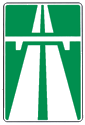 5.1 · Motorway
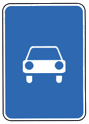 5.3 · Expressway
Law: Annex 1, sign 5.1 Annex 1, sign 5.3 Art. 33 ¶7(b.a)
Motorcycles, trucks and buses. Outside populated areas, vehicles of category A and of subcategories A1, A2 and B1 may drive at no more than 80 km/h on all roads. Categories C and CE, subcategories C1 and C1E, and categories D and DE may drive at up to 80 km/h on a motorway and 70 km/h on other roads. When carrying passengers in the body, as established, categories C and CE and subcategories C1 and C1E may drive at no more than 60 km/h on all roads. Subcategories D1 and D1E may drive at no more than 80 km/h on all roads.
The limits depend on the vehicle’s category: a motorcycle is category A, and a moped or a light quadricycle is category AM. A motorized tricycle or a quadricycle is subcategory B1, not a category B passenger car, so outside populated areas its limit is 80 km/h on all roads. A tractor is category T, and a motor vehicle whose maximum permissible mass exceeds 3 500 kg is category C, unless it is category D. A motor vehicle for passengers with more than 8 but no more than 16 seats besides the driver’s is subcategory D1, and with more seats, category D. The English exam questions often call a quadricycle a quadrocycle.
On a motorway, a category B passenger car, a category C truck, a bus and a subcategory D1 minibus are all doing 90 km/h. The passenger car’s limit there is 110 km/h and the others’ is 80 km/h, so three drivers break the rules. On an ordinary road outside populated areas a passenger car may do 90 km/h, but a motorcycle or a quadricycle only 80 km/h there too. The English exam questions often call a truck a lorry.
3 The lowest limit applies
2 2 exam questions on this sectionDesign speed and signs. Besides the limits for the place and the category, a driver must not exceed the maximum design speed set for the vehicle. They must not exceed either the speed shown on the “Speed limit” identification sign fixed to the vehicle, or the maximum speed set by a road sign.
Law: Art. 33 ¶9 ¶9(a) ¶9(b) ¶9(c)
Design speed is the maximum speed of a vehicle as set by its manufacturer. A slow-moving vehicle is a vehicle with an engine whose design speed does not exceed 40 km/h. A vehicle with an engine also counts as slow-moving if it cannot exceed that speed, or is barred from exceeding it for a reason unrelated to traffic flows. The threshold is exactly 40 km/h, and a vehicle without an engine is never a slow-moving vehicle. The English exam questions often call design speed constructive speed, and a slow-moving vehicle a low-speed vehicle.
Law: Art. 5 ¶29 ¶53
A sign does not raise the driver’s own limit. Even where a road sign or signal allows a higher speed, a driver must not exceed the maximum speed limit the law sets for them. Of all the limits that apply to a driver, the lowest one counts.
Law: Art. 33 ¶10
Sign 4.6 sets the minimum speed, and the blue square sign 7.2 only shows a recommended speed. Neither changes the maximum speed: that stays the limit for the place and the category. So in the zone of sign 4.6, the lower limit for a category B vehicle is the speed on the sign. The upper limit is 60 km/h in a populated area and 110 km/h on a motorway without a light trailer.
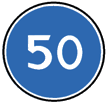 4.6 · Minimum Speed Limit
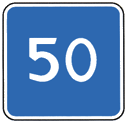 7.2 · Recommended Speed
Law: Annex 1, sign 4.6 Annex 1, sign 7.2 Art. 33 ¶6 ¶7(b.a)
Sign 3.25 marks the end of the zone of sign 3.24 and sets no speed of its own. A sign 3.24 inside a populated area with no intersection ahead stops applying at 5.24.1, at the end of the populated area. Past the end of the zone your own limit applies again: outside populated areas, 70 km/h for a category BE vehicle. More on this in the lesson on prohibitory signs.
 3.25 · End of Maximum Speed Limit
Law: Annex 1, sign 3.25 Annex 1, group 3, note 2 Annex 1, sign 5.24.1 Art. 33 ¶7 ¶7(c)
Sign 3.24 allows 60 km/h, but you are on a category AM moped: your limit is still 45 km/h. In a category B motor vehicle towing a light trailer, your limit also stays 80 km/h, even where a sign allows more.
4 Stopping distance and following distance
5 5 exam questions on this sectionA driver’s reaction time is the time from spotting a danger to taking the measures needed to avoid it. The measures are not taken yet and braking has not begun, but during that time the vehicle already covers some distance. After that, before stopping completely, it also covers its braking distance.
Law: Art. 5 ¶68
Braking distance is the distance a vehicle travels from the moment the brakes are applied until it comes to a complete stop. It depends on the vehicle’s speed, the state of the road surface and the wear of the tyres. If a passenger car’s trailer has no braking system, the braking distance grows. Together, the distance covered during the reaction time and the braking distance make up the whole distance to a complete stop: the stopping distance.
Law: Art. 5 ¶68
Stopping within what you can see. This follows from the duty to take the conditions into account. In the dark time of day or in insufficient visibility, the driver must choose a speed at which the stopping distance is shorter than what they can see. Otherwise an obstacle shows up in the headlights too late for stopping in time.
Law: Art. 33 ¶2 Art. 5 ¶7
Distance and lateral interval. A driver following another vehicle must keep a proper distance, so as to avoid a collision in case of sudden braking or stopping by the vehicle ahead. For traffic safety, a lateral interval must be kept as well.
Law: Art. 33 ¶11
The car ahead brakes hard. If the distance is short, stopping in time is impossible for the driver behind: a proper distance is needed for exactly this case.
5 Braking, bends and skids
16 16 exam questions on this sectionBrake sharply only to avoid an accident. A driver must not brake sharply, except when braking is needed to prevent a road traffic accident. Braking in an emergency, described below, is exactly that case.
Law: Art. 33 ¶4
In an emergency, you should shorten the braking distance by pressing the brake pedal sharply again and again, at the point where the wheels are about to lock. In a motor vehicle without an anti-lock braking system (ABS), you should press the pedal in pulses and avoid locking the wheels. That way it keeps its steering. A motor vehicle with ABS steers better while braking, but that is no reason to start braking later: what ABS gives you is steering.
If the brake pads get wet after driving through water, you should drive on and dry them by pressing the brake pedal briefly many times.
On a steep descent, the effective way to brake a motor vehicle with a manual gearbox is with the engine, not by pressing the brake pedal now and then. The steeper the descent, the lower the gear you should choose.
The faster you take a bend, the greater the centrifugal force, while the tyres’ grip on the road weakens as speed rises. A vehicle is the more stable against overturning, the lower its centre of gravity. A loaded vehicle has a higher centre of gravity than an empty one, so a passenger car is most stable in a bend with no passengers and no load.
In a bend, the front wheels run on the side away from the centre of the turn. The rear wheels of the motor vehicle or trailer run on the side towards it. The difference between the radii from the centre of the turn to these wheels is called the dynamic corridor. It is not the turning radius: there are two radii here, and the corridor is the difference between them. Trucks and buses need much more room in a bend.
If the rear axle of a rear-wheel-drive motor vehicle skids in a bend, you should ease off the fuel slightly and turn the steering wheel towards the skid. With front-wheel drive, on the contrary, you should add a little fuel and correct the direction with the steering wheel. To stop a skid caused by braking, you should stop braking. If sharp steering on a slippery road sets off a skid, you should turn the wheel towards the skid quickly but smoothly, then straighten your path.
If the right wheels of a motor vehicle drift onto a shoulder with a soft, wet surface, it is best to steer it smoothly back onto the carriageway without braking.
Key points
- Choose your speed for the road conditions, so that before any danger you can slow down or stop. Holding others up by driving far too slowly without a special reason is not allowed either.
- Unless the law says otherwise, no more than 60 km/h in a populated area, and 20 km/h in a residential zone. Everywhere: categories T and S 40 km/h, AM 45 km/h, and 50 km/h when towing a mechanical vehicle.
- Outside populated areas, category B may drive at up to 110 km/h on a motorway and 90 km/h on other roads, and at 80 km/h with a light trailer. Category BE may drive at 70 km/h on all roads. Category A and subcategories B1 and D1: 80 km/h; C and D: 80 km/h on a motorway and 70 km/h on other roads.
- The lowest limit applies: a sign that allows more does not raise the limit the law sets for the driver.
- The stopping distance is the reaction distance plus the braking distance. In the dark or in insufficient visibility it must be shorter than what you can see.
- It is best to brake without locking the wheels. On a steep descent in a motor vehicle with a manual gearbox, it is best to brake with the engine: the steeper the descent, the lower the gear.
Plain-language summary for exam preparation; the law's text prevails.
Now answer this lesson's questions
45 exam questions are about this lesson. A wrong answer comes back until you get it right, and you see which questions are ready for the exam.
Practise the questionsFree account · sign in with e-mail or Google
The law behind this lesson
45 exam questions
Practise the questions