
Lesson 15 of 29 · Moving on the road
Moving off, turning, U-turns, reversing
10 min 49 questions
Turns, U-turns, lane changes, reversing and even moving off are all maneuvers, and they share a set of rules. This lesson covers how a driver makes sure a maneuver is safe and how to signal it. Then comes the position to take before a turn, and who gives way to whom. Last come the places where U-turns and reversing are banned.
1 Every maneuver starts with a check
A maneuver is moving off, turning right or left, making a U-turn, reversing, going around an obstacle or changing lanes. Pulling away from the sidewalk or after stopping is a maneuver too. So when moving off, the driver follows all the general rules for maneuvers.
Law: Art. 5 ¶31
First make sure it is safe. A driver who intends to make a maneuver must start it only after making sure it will not endanger other road users. That covers everyone moving behind, ahead and alongside, both in the same direction and in the opposite one. The driver takes into account where they are, which way they are going and how fast.
Law: Art. 32 ¶1
A car has stopped at the edge of the carriageway and is about to pull away. Another car comes up from behind, heading for the edge to stop in front of it, and their paths cross. Pulling away is a maneuver, so the first driver starts only after making sure the car behind is not endangered.
2 Indicators and hand signals
Indicate before every maneuver. Before starting a maneuver, the driver must switch on the turn indicator for that direction. If there is none, or it is out of order, the driver must signal by hand. This applies anywhere, for example in a residential zone or on adjacent territory, and always, even with nobody behind.
Law: Art. 32 ¶2
On in good time, off straight after. The signal, by indicator or by hand, must be given in good time before the maneuver starts and stopped as soon as it is over. A hand signal may end just before the maneuver begins. The signal must not mislead other road users.
Law: Art. 32 ¶2
A signal gives no priority. Signalling by indicator or by hand gives the driver no priority. The driver still has to take the necessary precautions.
Law: Art. 32 ¶2
By hand, a left turn or U-turn is signalled with the left arm stretched out sideways, horizontally. The same signal is the right arm stretched out sideways and bent upwards at the elbow at a right angle. A right turn is the right arm stretched out sideways, horizontally, or the left arm stretched out sideways and bent upwards at the elbow at a right angle. Braking is the left or right arm raised vertically upwards.
Law: Art. 32 ¶2
3 The extreme position before a turn
Turn from the extreme position. Before turning right or left or making a U-turn, a vehicle’s driver must take the matching extreme position in good time on the carriageway for traffic in their direction. The exception is a turn made to enter an intersection with circular traffic.
Law: Art. 32 ¶5
So, except when turning to enter an intersection with circular traffic, a driver turns right from the rightmost lane in their direction and left or U-turns from the leftmost. With only one lane in your direction, it is the extreme lane on both sides. The extreme-position rule does not stop you going straight on.
Law: Art. 32 ¶5
You are in the left of two lanes in your direction, with another lane to your right. A traffic light or a traffic controller opens the way to the right, but does not cancel the extreme-position rule. So you may not turn right from this lane: you are not in the extreme right position. That rule does not stop you going straight on, turning left or making a U-turn from here.
How to turn and where to come out. Before turning right, the vehicle must keep as close as possible to the right edge of the carriageway and then make the shortest maneuver it can. Before turning left, it must get as close as it can to the axis of the carriageway, or on a one-way road to its left edge. If the turn leads onto a two-way road, the vehicle must not be on the side of oncoming traffic as it leaves the crossing of carriageways. After a left turn, the driver may enter any lane of their side the lane rules allow: outside populated areas, for example, not the left while the right is free.
Law: Art. 32 ¶7 ¶7(a) ¶7(b) Art. 31 ¶11
Tram tracks on the left: turn from the tracks. If there are tram tracks for your direction on your left, level with the carriageway, a driver must make left turns and U-turns from those tracks. The exception is when signs 5.15.1 or 5.15.2 set a different order: then the left turn or U-turn is made from the lane the sign shows, not from the tracks. The driver must not obstruct the tram while doing so.
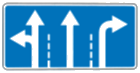 5.15.1 · Lane Direction Indicators
 5.15.2 · Direction in Lane
Law: Art. 32 ¶6 Annex 1, sign 5.15.1 Annex 1, sign 5.15.2
An island on the axis: pass on the right only. A driver may pass a safety island, a bollard or another device on the carriageway they are driving on, on the right or on the left. If a road sign shows which side to use, the driver must pass on that side. With no sign, an island, bollard or device on the axis of the carriageway of a two-way road must be passed on the right only.
Law: Art. 32 ¶17 ¶17(a) ¶17(b)
4 Joining and leaving the road
From adjacent territory: give way to traffic on the road. When joining a road from adjacent territory, the driver must give way to vehicles and pedestrians moving on the road. When leaving the road, the driver must give way to pedestrians and to riders of bicycles, bicycles with auxiliary engines and two-wheeled electric self-balancing vehicles whose path they cross. Adjacent territory is, for example, a yard, a car park or a filling station.
Law: Art. 32 ¶3 Art. 5 ¶38
Deceleration lane: move over first, then slow down. Where there is a deceleration lane, a driver who intends to turn must move onto it in good time and then reduce speed. The slowing down happens in that lane, not in the main lane before it.
Law: Art. 32 ¶13
Acceleration lane: use it, then give way. Where there is an acceleration lane at the point of joining a road, the driver must drive along it. Moving from it into the next lane, the driver must give way to vehicles travelling in that lane. The acceleration lane lies on the right, but this gives the driver leaving it no priority.
Law: Art. 32 ¶14
Left turn or U-turn outside an intersection: give way to oncoming traffic and trams. When turning left or making a U-turn outside an intersection, the driver of a trackless vehicle must give way to vehicles coming the opposite way. The driver must also give way to trams going the same way. This is the case, for example, when turning left into a yard.
Law: Art. 32 ¶9
5 Lane changes and crossing paths
Changing lanes: give way to those in the new lane. When changing lanes without changing direction, a driver must give way to vehicles travelling the same way in the lane they are moving into. Changing lanes does not in itself give priority.
Law: Art. 32 ¶4
Both changing lanes: the one on the right goes first. If vehicles going the same way change lanes at the same time and their paths cross, priority goes to the driver of the vehicle on the right. Right and left are counted in the direction the vehicles travel: seen from the front, a car’s right is on your left.
Law: Art. 32 ¶4
This rule protects everyone already travelling in the lane the driver moves into, the extreme right lane by the edge of the carriageway included. Such a vehicle is not moving off: moving off means starting to move after stopping. Moving off follows the general rule for maneuvers: the driver starts only after making sure no other road user will be endangered.
Law: Art. 32 ¶4 ¶1 Art. 5 ¶31
No set order: give way to the vehicle on the right. If the paths of vehicles cross and the order of passing is not set, a driver must give way to the vehicle approaching from the right. The order is set, for example, by priority signs, a traffic light or a traffic controller. More on this in the lesson on intersections.
Law: Art. 32 ¶12
A car has entered an intersection with circular traffic past sign 2.3 and is driving in the outer lane. To its left, another car is moving over from the inner lane towards an exit, and their paths cross. Sign 2.3 applies only to the crossing of carriageways in front of which it stands, that is, the entry. So the driver moving over from the inner lane must give way: the car in the outer lane is on their right.
A driver is turning right onto a road with a pedestrian crossing at its entrance. A motorcycle is coming from the right, and their paths cross. No order is set, so the driver gives way to the motorcycle. Approaching the crossing, the driver slows down so as not to endanger pedestrians who have stepped or are stepping onto it, and stops to let them cross if necessary.
6 Bans on U-turns and reversing
Where U-turns are prohibited. A vehicle must not make a U-turn on pedestrian crossings, in tunnels, on and under bridges, overpasses and viaducts, and on railway crossings. It is also prohibited on a road where visibility in at least one direction is under 100 m, and at a public transport stop, for example at sign 5.16. The law bans U-turns in a few other places too, for example on a motorway.
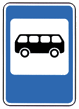 5.16 · Bus or Trolleybus Stop
The ban covers the place itself. These bans cover the place itself: the bridge and the space under it, the railway crossing, the pedestrian crossing. You may make a U-turn or reverse before a bridge or a railway crossing if the whole maneuver happens before it. That holds only if no other rule bans it, for example the ban at a public transport stop. A U-turn whose path runs over a pedestrian crossing or a railway crossing, or under a bridge, is prohibited too.
Make sure before a U-turn or reversing. A driver who intends to make a U-turn or reverse must make sure the maneuver can be done without endangering or obstructing other road users.
Law: Art. 32 ¶16
Where reversing is prohibited. Reversing is prohibited at intersections, on motorways and in all the places listed above where the law prohibits a U-turn. So you may not reverse back to a turn you missed at an intersection either.
Law: Art. 32 ¶16
Key points
- Moving off is a maneuver too. Any maneuver starts only once the driver is sure it will not endanger others, and a switched-on indicator gives no priority.
- The indicator goes on before every maneuver, in good time, and off as soon as the maneuver is over.
- Right turns are made from the extreme right position, left turns and U-turns from the extreme left. After a left turn the vehicle must not end up on the side of oncoming traffic.
- Joining from adjacent territory, give way to vehicles and pedestrians on the road. Changing lanes, give way to those in the lane you move into. Where paths cross and no order is set, give way to the vehicle on the right.
- U-turns are prohibited on pedestrian crossings, in tunnels, on and under bridges, on railway crossings, at stops and where visibility in at least one direction is under 100 m. Reversing is prohibited in the same places, and at intersections and on motorways too.
Plain-language summary for exam preparation; the law's text prevails.
Now answer this lesson's questions
49 exam questions are about this lesson. A wrong answer comes back until you get it right, and you see which questions are ready for the exam.
Practise the questionsFree account · sign in with e-mail or Google
The law behind this lesson
49 exam questions
Practise the questions