
Lesson 17 of 29 · Moving on the road
Overtaking and passing oncoming traffic
9 min 46 questions
When you overtake, you leave your own lane for a while. This lesson covers which side to overtake on, what to make sure of before you start, and where overtaking is banned. It also covers what the driver being overtaken does, and who lets whom pass when passing oncoming traffic, including on a steep road.
1 Which side overtaking is done on
40 40 exam questions on this sectionOvertaking is passing one or more vehicles moving ahead in the same lane and in the same direction, by leaving the lane you occupy. A driver who stays in their own lane and simply moves faster than the cars in the next lane is not overtaking. A driver who moves out of their lane to get past a vehicle ahead in it is overtaking, on whichever side they pass.
Law: Art. 5 ¶10 Art. 34 ¶1
On the left; on the right past a driver turning left. Overtaking must be done on the left. You may overtake on the right if the driver being overtaken has signalled a left turn and has already steered their vehicle that way. A driver does this when about to turn onto another road, enter an adjacent territory or stop on the left side. Low speed alone, such as a tractor’s, is no reason to overtake on the right.
Law: Art. 34 ¶1
Service vehicles. Overtaking, going around or passing an operational service vehicle stopped on the road with its blue flashing light on is allowed on the right as well as on the left. You may likewise overtake, go around or pass a stopped special or road maintenance service vehicle with an orange or yellow flashing light on. The same goes for a technical service vehicle moving slowly and for utility workers doing road works. The side depends on their position, the situation and the danger, whatever the road signs and horizontal road markings there say.
Law: Art. 34 ¶18
2 Before and during overtaking
What to make sure of. Before overtaking, the driver must make sure that no driver behind has started overtaking. The driver must also make sure that the driver ahead in the same lane has not signalled an intention to overtake another vehicle. The overtaking must be possible without creating danger or obstruction for other road users. The lane the driver moves out into must be clear over a sufficient distance, and the speeds must allow overtaking in a sufficiently short time.
Law: Art. 34 ¶3 ¶3(a) ¶3(b) ¶3(c)
A vehicle that is overtaking or going around. Overtaking a vehicle that is itself overtaking or going around an obstacle is prohibited.
Law: Art. 34 ¶3(b) ¶9(c)
Solo motorcycles and towing. A motorcycle without a sidecar, that is without a side trailer, must not tow, and must not be towed.
Law: Art. 45 ¶6(d)
Ahead of you, a motorcycle without a side trailer is towing another motorcycle and starts going around a stopped truck. Overtaking them now is prohibited: they are going around an obstacle. The towing itself is prohibited too.
When to give up overtaking. If an obstacle or danger appears during overtaking that the driver could not have taken into account before starting, the driver must stop overtaking. The driver must do the same if they could not assess the situation correctly. The drivers of vehicles behind must let the driver return to the lane previously occupied.
Law: Art. 34 ¶17
3 The driver being overtaken
Keep right and do not speed up. When the driver of a vehicle behind intends to start overtaking, the driver ahead must move as close as possible to the right edge of the carriageway. That driver must not speed up. The exception is when that driver is turning left and has moved to the centre line or the left edge of the carriageway to do so.
Law: Art. 34 ¶12 Art. 32 ¶7(b)
Do not hinder the overtaking. The driver of the vehicle being overtaken must not obstruct the overtaking by speeding up or in any other way.
Law: Art. 34 ¶16
4 Intersections and railway crossings
At and just before an intersection. Overtaking is prohibited at an intersection, other than a roundabout, and directly before it. The ban does not apply where you may overtake on the right, nor on a road that gives the driver priority at the intersection. Such a road is, for example, a main road with sign 2.1, or a road where sign 1.7.1 or one of signs 1.7.2–1.7.7 stands before the intersection. Sign 1.6 warns of an intersection of equal roads, where there is no main road, so this exception does not apply before it.
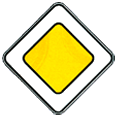 2.1 · Main Road
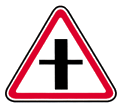 1.7.1 · Intersection with Secondary Road (Both Sides)
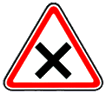 1.6 · Intersection of Roads of Equal Importance
Law: Art. 34 ¶9 ¶9(a) ¶9(a.a) ¶9(a.b) Annex 1, sign 2.1 Annex 1, sign 1.7.1 Annex 1, sign 1.6
You are approaching an intersection. The driver of the truck ahead has switched on the left indicator and moved over to the left to turn. You may overtake it on the right here: the ban on overtaking at intersections does not cover such an overtaking.
Two-wheeled bicycles, mopeds and solo motorcycles. The bans on overtaking at intersections and railway crossings do not apply to overtaking two-wheeled bicycles, two-wheeled mopeds and two-wheeled motorcycles without a sidecar. You may overtake such a motorcycle even directly before an intersection of equal roads.
Law: Art. 34 ¶10
A regulated intersection. At a regulated intersection, you may overtake without moving out into the oncoming lane. This applies to any vehicle being overtaken, a motorcycle with a sidecar for example. Overtaking there by moving out into the oncoming lane is prohibited, even on a main road, unless the vehicle overtaken is a two-wheeled bicycle, moped or motorcycle without a sidecar. The English exam questions sometimes call a regulated intersection a regular intersection, and a motorcycle with a sidecar a three-wheeler.
A railway crossing and 100 metres before it. Overtaking is prohibited on a railway crossing and less than 100 metres before it. The exception is a crossing where traffic is regulated by a traffic light of the type used at intersections.
Law: Art. 34 ¶9(b)
Outside populated areas, the railway crossing approach signs on the right-hand side of the road give extra warning of a crossing. Sign 1.4.1 with three red stripes stands with the main sign 1.1 or 1.2, 150–300 metres before the crossing: overtaking is not yet banned there. Sign 1.4.3 with one red stripe stands closer to the crossing, with the duplicating sign 1.1 or 1.2. Once level with it, the driver is already inside the banned zone.
 1.4.1 · Approaching Railway Crossing
 1.4.3 · Approaching Railway Crossing
Law: Art. 34 ¶9(b) Annex 1, sign 1.4.1 Annex 1, sign 1.4.3 Annex 1, group 1, note 1
5 Restricted visibility, pedestrian crossings and signs
1 1 exam question on this sectionRestricted visibility is when a sharp bend, the top of a rise, greenery, a roadside structure or an obstacle on the road cuts the view of the road ahead. The view is cut so much that driving at the maximum permitted speed on that section could create a hazard. Tunnels, darkness, fog, rain and snowfall are a different matter: when they cut the view of the road to less than 300 metres, that is insufficient visibility, a different term. The English exam questions often call restricted visibility limited visibility.
Law: Art. 5 ¶89 ¶7
The oncoming lane is off-limits. Under restricted visibility, overtaking by moving out into the oncoming lane is prohibited. You may overtake there without moving into the lanes meant for oncoming traffic, where there is a matching longitudinal road marking. A bend or the top of a rise does not ban overtaking by itself, where there is such a marking and you need not move into the oncoming lane.
Law: Art. 34 ¶9(e) ¶4
The road climbs steeply, and oncoming traffic beyond the top cannot be seen. The uphill direction has two lanes here, and the oncoming lanes are separated by road markings. Overtaking a truck in the left lane of your own direction is allowed. Moving out into the oncoming lane to overtake is prohibited.
Pedestrian crossings. You may overtake a vehicle approaching a pedestrian crossing or stopped just before it only at a speed low enough for stopping in time for a pedestrian. Overtaking on a pedestrian crossing is prohibited while a pedestrian is crossing it. The 100-metre distance does not apply to pedestrian crossings; it is set for railway crossings.
Law: Art. 34 ¶11 ¶9(b)
A sign or a marking. Overtaking is prohibited at a place defined by a sign or road marking prohibiting it, for example in the zone of sign 3.20. This sign does not ban overtaking a vehicle slower than 30 km/h, and allows overtaking a motorcycle without a sidecar, moped or bicycle without crossing to the oncoming side. You must not overtake either if that would mean crossing a line that must not be crossed, line 1.1 for example. More on this in the lessons on prohibitory signs and road markings.
Law: Art. 34 ¶9(d) Annex 1, sign 3.20 Annex 2, marking 1.1
6 Passing oncoming traffic
5 5 exam questions on this sectionAn obstacle on the driver’s own side. When passing oncoming traffic, the driver must leave enough free space to the side and, if necessary, keep closer to the right edge of the carriageway. If an obstacle or other road users on the driver’s own side get in the way, the driver must slow down. If necessary, the driver must stop to let the oncoming vehicles pass.
Law: Art. 35 ¶1
On a steep slope, the driver going down gives way. A special rule applies on mountain roads, steep roads and roads with signs 1.14 (Steep Descent) and 1.15 (Steep Ascent), where passing is impossible or difficult. There, whichever side the obstacle is on, the driver of a vehicle going downhill must stop and give way to the driver of a vehicle going uphill. The exception is when stopping at a passing place just ahead is possible for the uphill driver, given their speed and position, so that nobody needs to reverse.
 1.14 · Steep Descent
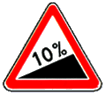 1.15 · Steep Ascent
Law: Art. 35 ¶2 Annex 1, sign 1.14 Annex 1, sign 1.15
Sign 1.15 (Steep Ascent) stands on the right as you drive: you are about to climb, and the oncoming driver is about to go down. A car is stopped ahead in your lane. On an ordinary road you would have to give way, as the obstacle is on your side. Here, though, the oncoming driver going downhill stops and gives way.
Who does not have to reverse. If one of the two vehicles must reverse so they can pass, the driver of a combination of vehicles has priority over all others. The driver of a heavy vehicle has priority over the driver of a light one, and a bus driver over the drivers of trucks and passenger cars. A bus driver has no priority over the driver of a combination of vehicles. The English exam questions call a combination of vehicles a pack of vehicles.
Law: Art. 35 ¶2
Vehicles of the same category. If both vehicles are of the same category or subcategory, the one going downhill must reverse. The exception is when it is obvious that the uphill driver can perform this maneuver more easily, in particular when that driver is near the passing place.
Law: Art. 35 ¶2
Key points
- Overtaking means passing vehicles ahead by leaving your own lane, and it is done on the left. You may overtake on the right if the driver ahead has signalled a left turn and has already moved over that way.
- Before overtaking, make sure nobody behind has started overtaking and the driver ahead has not signalled an overtaking. Overtaking a vehicle that is itself overtaking or going around an obstacle is prohibited, and an unforeseen danger means giving up the overtaking.
- Overtaking is prohibited at an intersection other than a roundabout and directly before it. The exceptions are a road with priority at that intersection, a permitted overtaking on the right, and a regulated intersection without moving into the oncoming lane. At a railway crossing without an intersection-type traffic light, the ban starts 100 metres before it. Neither ban covers two-wheeled bicycles, mopeds and motorcycles without a sidecar.
- Under restricted visibility, overtaking by moving out into the oncoming lane is prohibited. Near a pedestrian crossing you overtake at reduced speed, and overtaking on it is prohibited while a pedestrian is crossing.
- When you are being overtaken, keep close to the right edge and do not speed up.
- On a mountain road or a steep road where passing is difficult, the driver going downhill gives way, whichever side the obstacle is on. The exception is when the uphill driver can stop at a passing place just ahead. When someone must reverse, a combination of vehicles has priority over everyone, and a bus over trucks and passenger cars.
Plain-language summary for exam preparation; the law's text prevails.
Now answer this lesson's questions
46 exam questions are about this lesson. A wrong answer comes back until you get it right, and you see which questions are ready for the exam.
Practise the questionsFree account · sign in with e-mail or Google
The law behind this lesson
46 exam questions
Practise the questions