
Lesson 11 of 29 · Signs and markings
Special-instruction and information signs
8 min 28 questions
This lesson covers special-instruction signs and information signs. Special-instruction signs set or cancel a special traffic regime: on a whole road, in one lane or over an entire area. Information signs tell you where populated areas and other places are, and what speed is recommended. Many signs in both groups are blue rectangles, so the main skill here is telling them apart by their pictures.
The signs of both groups and their meanings are set out in the first annex to the Law of Georgia on Road Traffic.
Law: Annex 1, group 5 Annex 1, group 7
1 A special regime for a whole road
12 12 exam questions on this sectionSpecial-instruction signs set or cancel a special traffic regime. Most of them are blue rectangles or squares with a white picture. The sign that cancels a regime usually repeats the same picture, crossed out.
Law: Annex 1, group 5
Motorway and merging point. Sign 5.1 marks a motorway, where the rules for driving on motorways apply, and sign 5.2 marks its end. The English exam questions often call a motorway a highway. Sign 5.36 marks the point where an exit from another road (the acceleration lane) merges with the motorway. Here vehicles from the acceleration lane join a lane of the motorway, and the roads do not cross.
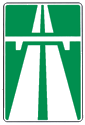 5.1 · Motorway
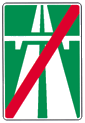 5.2 · End of Motorway
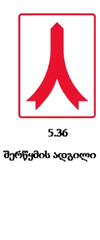 5.36 · Merging Point
Law: Annex 1, sign 5.1 Annex 1, sign 5.2 Annex 1, sign 5.36
A road for motor vehicles and motorcycles only. Sign 5.3 marks an expressway, a road intended only for motor vehicles and motorcycles, and sign 5.4 marks its end. The English exam questions often call this road a motorroad. Both signs concern the whole road, not a single lane.
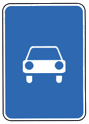 5.3 · Expressway
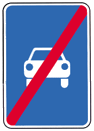 5.4 · End of Expressway
Law: Annex 1, sign 5.3 Annex 1, sign 5.4
One-way traffic across the whole width. Sign 5.5 marks a road or carriageway where vehicles move in one direction across its whole width. Sign 5.6 marks its end. Signs 5.7.1 and 5.7.2 mark an exit onto such a road and stand before every side entry to it. The arrow on sign 5.5 is about the whole width of the road, not the direction of one lane.
 5.5 · One-Way Road
 5.6 · End of One-Way Road
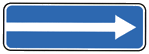 5.7.1 · Exit onto One-Way Road
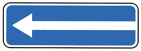 5.7.2 · Exit onto One-Way Road
Law: Annex 1, sign 5.5 Annex 1, sign 5.6 Annex 1, sign 5.7.1 Annex 1, sign 5.7.2
Reversible traffic. Sign 5.8 marks the start of a section of road where the direction of traffic in one or more lanes can be reversed. Sign 5.9 marks the end of that section. Sign 5.10 marks an exit onto such a section and stands before every side exit onto it. The double-headed arrow on these signs means reversible traffic, not an ordinary two-way road.
 5.8 · Reversible Traffic
 5.9 · End of Reversible Traffic
 5.10 · Exit onto Reversible Traffic Road
Law: Annex 1, sign 5.8 Annex 1, sign 5.9 Annex 1, sign 5.10
Sign 5.20 marks an artificial hump on the carriageway.
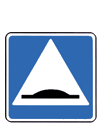 5.20 · Road Hump
Law: Annex 1, sign 5.20
2 Lanes and their directions
7 7 exam questions on this sectionThe signs in this section are about lanes. They are blue too, but they show the lanes themselves, as lines and arrows, sometimes with a bus.
Law: Annex 1, sign 5.11 Annex 1, sign 5.15.1 Annex 1, sign 5.15.8
A lane for route vehicles. Sign 5.11 marks a road where route vehicles use a specially set-aside lane against the general flow, and sign 5.12 marks the end of that road. Sign 5.14 marks a lane where they move with the general flow. Signs 5.11 and 5.14 apply only to the lane on which they stand, not to the whole width of the carriageway. Sign 5.14 on the right side of the road applies to the rightmost lane of the carriageway.
 5.11 · Road with Lane for Route Service Vehicles (Counter-Flow)
 5.12 · End of Road with Lane for Route Service Vehicles
 5.14 · Lane for Route Service Vehicles
Law: Annex 1, sign 5.11 Annex 1, sign 5.12 Annex 1, sign 5.14
An exit onto a road with a lane for route vehicles. Signs 5.13.1 and 5.13.2 mark an exit onto a road marked with sign 5.11. They stand before every side entry to that road.
 5.13.1 · Exit onto Road with Counter-Flow Route Service Lane
 5.13.2 · Exit onto Road with Counter-Flow Route Service Lane
5.11 · Road with Lane for Route Service Vehicles (Counter-Flow)
Law: Annex 1, sign 5.13.1 Annex 1, sign 5.13.2 Annex 1, sign 5.11
Where a lane may lead. Sign 5.15.1 shows the number of lanes and the directions allowed in each, and sign 5.15.2 the directions allowed in one lane. From a lane you may drive, U-turns included, only in the directions that lane’s own sign shows. If the signs allow a turn from the leftmost lane, you may also make a U-turn from that lane. Signs 5.15.1 and 5.15.2 do not apply to route vehicles.
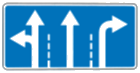 5.15.1 · Lane Direction Indicators
 5.15.2 · Direction in Lane
Law: Annex 1, sign 5.15.1 Annex 1, sign 5.15.2 Annex 1, group 5, note 1
Valid for the whole intersection. Signs 5.15.1 and 5.15.2 placed before an intersection apply to the whole intersection, unless other such signs on it give a different instruction. They do not apply to route vehicles.
Law: Annex 1, group 5, note 1
You approach an intersection with three lanes, each with sign 5.15.2 above it. The left sign points left, the middle one straight ahead, the right one straight and right. From the leftmost lane you may turn left or make a U-turn; from the middle lane you may only go straight. You may turn right only from the right lane.
Sign 5.15.8 shows both the number of lanes in that direction and the regimes set for traffic in them.
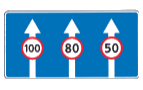 5.15.8 · Number of Lanes
Law: Annex 1, sign 5.15.8
3 Populated areas and zones
3 3 exam questions on this sectionSigns 5.23.1 and 5.24.1 show where an ordinary populated area begins and ends. More on this in the lesson on the road and road users. Sign 5.23.2 marks the start of a stretch of road with buildings along it that belongs to no populated area (holiday villages, stand-alone institutions and so on). The rules for driving in populated areas apply there too, and sign 5.24.2 marks the end of that stretch. The English exam questions often call a populated area an inhabited area.
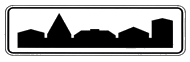 5.23.2 · Beginning of a Built-Up Area
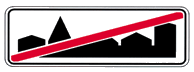 5.24.2 · End of a Built-Up Area
Law: Annex 1, sign 5.23.1 Annex 1, sign 5.23.2 Annex 1, sign 5.24.1 Annex 1, sign 5.24.2
Blue background: no populated-area rules. Sign 5.25, on a blue background, marks the beginning of a populated area where the rules for driving in populated areas do not apply. Sign 5.26 marks the end of such a populated area. Every end-of-populated-area sign is crossed out, so they are told apart by their background. A white one ends a populated area where those rules applied, a blue one a populated area where they did not.
 5.25 · Beginning of Built-up Area (No Built-up Rules)
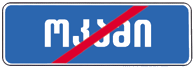 5.26 · End of Built-up Area
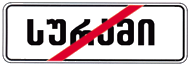 5.24.1 · End of Built-up Area
5.24.2 · End of a Built-Up Area
Law: Annex 1, sign 5.25 Annex 1, sign 5.26 Annex 1, sign 5.24.1 Annex 1, sign 5.24.2
Residential zone. Sign 5.21 marks a residential zone, an area where the rules for driving in a residential zone apply, and stands at every entry to it. Sign 5.22 marks the end of the residential zone and stands at every exit from it. It ends the residential zone, not a populated area: it shows a motor vehicle, a pedestrian and a child, which populated-area signs do not show. The English exam questions often call a residential zone a built-up area.
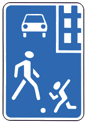 5.21 · Residential Zone
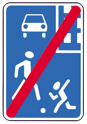 5.22 · End of Residential Zone
Law: Annex 1, sign 5.21 Annex 1, sign 5.22
Zones: one regime for a whole area. Signs 5.27 and 5.29 mark areas within which parking is regulated, and sign 5.31 an area where the maximum speed is limited. These signs stand at every entry to the area, and the end-of-zone signs at every exit. The sign drawn on the zone sign shows what the zone regulates.
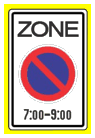 5.27 · Restricted Parking Zone
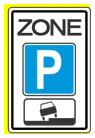 5.29 · Controlled Parking Zone
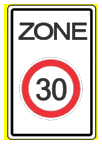 5.31 · Maximum Speed Limit Zone
Law: Annex 1, group 5, note 4 Annex 1, group 5, note 5
4 Traffic signs that inform
6 6 exam questions on this sectionAn information sign tells road users where populated areas and other places on the road are, and at what speed driving is recommended. In shape these signs look like special-instruction signs: mostly blue rectangles.
Law: Annex 1, group 7
General speed limits at the entry to Georgia. Sign 7.1 gives information on the general speed limits set by the road traffic rules on Georgia’s roads. It stands where you enter Georgia, at the checkpoints.
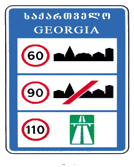 7.1 · General Speed Limits
Law: Annex 1, sign 7.1
Sign 7.2 shows the speed at which driving is recommended on that section of road. It applies up to the nearest intersection, or, together with a warning sign, along the whole dangerous section. The round sign 4.6 sets a minimum speed limit, while the square sign 7.2 only advises, so you can drive slower than it shows.
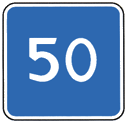 7.2 · Recommended Speed
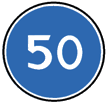 4.6 · Minimum Speed Limit
Law: Annex 1, sign 7.2 Annex 1, sign 4.6
A place for a U-turn. Sign 7.3.1 marks a place for making a U-turn. It stands before that place or above it, or in advance together with plate 8.1.1. It does not give the right to turn left.
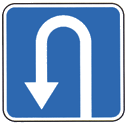 7.3.1 · U-Turn Place
Law: Annex 1, sign 7.3.1
Sign 7.5 shows that there is an emergency stopping strip on a steep descent. It stands before the entry to that strip.
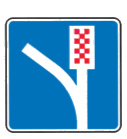 7.5 · Emergency Escape Lane
Law: Annex 1, sign 7.5
Signs 7.15.1, 7.15.2 and 7.15.3 show the direction that is recommended for trucks, tractors and self-propelled machines when their movement in one of the directions at an intersection is prohibited. It is advice, not a requirement: the sign does not force the driver to take that direction and does not concern other vehicles.
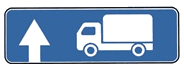 7.15.1 · Recommended Route for Goods Vehicles
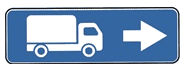 7.15.2 · Recommended Route for Goods Vehicles
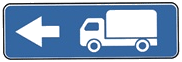 7.15.3 · Direction of Movement for Trucks
Law: Annex 1, sign 7.15.1 Annex 1, sign 7.15.2 Annex 1, sign 7.15.3
The prohibition itself is set by another sign, for example 3.1 with plate 8.4.1. The plate shows the type of vehicle the main sign applies to. If it shows a truck, the main sign concerns trucks only. The English exam questions often call a truck a lorry.
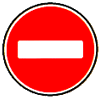 3.1 · No Entry
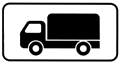 8.4.1 · Vehicle Type
Law: Annex 1, sign 3.1 Annex 1, sign 8.4.1
Stop line: the stopping place. Sign 7.16 marks the stopping place for vehicles at regulated intersections and unregulated railway crossings. It neither requires giving way nor forbids moving on without stopping: those are the requirements of sign 2.4. More on what to do at a stop line under traffic light signals in the lesson on traffic lights.
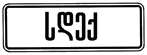 7.16 · Stop Line
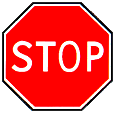 2.4 · No Entry Without Stopping
Law: Annex 1, sign 7.16 Annex 1, sign 2.4
Key points
- Special-instruction signs set or cancel a special traffic regime; the sign that cancels it is usually crossed out.
- The signs for an expressway, meant for motor vehicles and motorcycles, and for a one-way road concern the whole road, not a single lane.
- Signs of a lane for route vehicles apply only to the lane they stand on. From a lane you may drive only in the directions its sign shows, and from the leftmost lane that allows a turn you may also make a U-turn.
- End-of-populated-area signs differ by background: a white one ends a populated area where the rules for populated areas applied, a blue one a populated area where they did not.
- The recommended speed and the direction recommended for trucks are advice only.
- The general speed limits sign stands at the entry to Georgia, at the checkpoints. The stop line sign shows the stopping place at regulated intersections and unregulated railway crossings.
Plain-language summary for exam preparation; the law's text prevails.
Now answer this lesson's questions
28 exam questions are about this lesson. A wrong answer comes back until you get it right, and you see which questions are ready for the exam.
Practise the questionsFree account · sign in with e-mail or Google
28 exam questions
Practise the questions