
Lesson 10 of 29 · Signs and markings
Mandatory signs
6 min 22 questions
Round blue signs show the driver which way to go, on which side to pass an obstacle and how to drive through an intersection with roundabout traffic. You will see where each sign’s action begins and ends, and which vehicles it does not bind. Then come the signs that set a traffic regime on a stretch of road: the bicycle path, the minimum speed and snow chains.
The signs in this lesson are set out in the first annex to the Law of Georgia on Road Traffic.
Law: Annex 1, group 4
1 Only where the arrows point
4 4 exam questions on this sectionA mandatory sign is a blue circle with a white symbol and no red border. For example, these signs show which way to go or on which side to pass an obstacle, or they set a minimum speed. The direction signs usually act at the crossing of carriageways they stand before, and the minimum speed sign up to the nearest intersection.
Law: Annex 1, group 4 Annex 1, group 4, note 1 Annex 1, sign 4.6
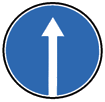 4.1.1 · Straight Ahead Only
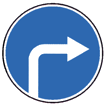 4.1.2 · Right Turn Only
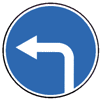 4.1.3 · Left Turn Only
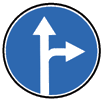 4.1.4 · Straight or Right
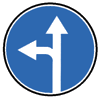 4.1.5 · Straight or Left
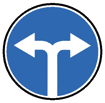 4.1.6 · Right or Left
Arrows only; a U-turn needs a left arrow. At a direction sign you may drive only in the directions its arrows show. If the sign allows a left turn, you may also make a U-turn. If the sign has no arrow to the left, a U-turn is prohibited. Signs 4.1.1–4.1.6 do not apply to route vehicles.
Law: Annex 1, group 4 Annex 1, group 4, note 1
The square blue sign 5.5 also shows an arrow, but it only marks a road or carriageway on which vehicles travel one way across its whole width. The round sign 4.1.1 allows straight ahead only.
 5.5 · One-Way Road
4.1.1 · Straight Ahead Only
Law: Annex 1, sign 5.5
So signs 4.1.3, 4.1.5 and 4.1.6 allow a U-turn, and signs 4.1.1, 4.1.2 and 4.1.4 do not. The English exam questions sometimes call a U-turn “swerving”.
Law: Annex 1, group 4, note 1
No reversing at an intersection. Reversing at an intersection is prohibited. So you may not reverse back to a turn you missed at an intersection either. More on this in the lesson on turns and U-turns.
Law: Art. 32 ¶16
You have gone past a right turn whose sign allowed only straight on or right. A U-turn is not allowed here, because the sign has no arrow to the left. Nor may you reverse back to the turn, since you are at an intersection.
2 Where direction signs apply
10 10 exam questions on this sectionOnly the crossing the sign stands before. A direction sign applies to the crossing of carriageways it stands before. It no longer applies at the next crossing of carriageways, even within the same intersection. The English exam questions often call a crossing of carriageways a crossing of the driveways.
Law: Annex 1, group 4, note 1
A sign allowing straight ahead only stands before the crossing with a road on the right. You may not turn right into that road. This sign does not ban a left turn into the road on the left, even within the same intersection. It allows going straight across the crossing with the road on the right, and the left turn is made at the next crossing of carriageways.
4.1.1 · Straight Ahead Only
The prohibitory road signs 3.18.1 and 3.18.2 work the same way: they too apply to the crossing of carriageways they stand before.
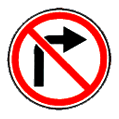 3.18.1 · No Right Turn
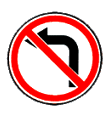 3.18.2 · No Left Turn
Law: Annex 1, group 3, note 2
At the start of a stretch: up to the intersection, not at it. If sign 4.1.1 stands at the start of a stretch of road, with the intersection further ahead, it applies up to the nearest intersection. At that intersection itself it no longer limits your direction, U-turns included.
4.1.1 · Straight Ahead Only
Law: Annex 1, group 4, note 1
Into a yard: right turns only. On that stretch, sign 4.1.1 does not prohibit turning right to enter a yard or other territory adjacent to the road. Turning left to enter a yard is prohibited.
4.1.1 · Straight Ahead Only
Law: Annex 1, group 4, note 1
You are driving along a street that begins with a straight-ahead-only sign. You may turn right into a yard on your side, but not left into a yard across the street. At the nearest intersection the sign no longer limits you.
Sign 3.27 prohibits both stopping and parking of vehicles from the sign to the nearest intersection or, in a populated area with no intersection, to its end. It does not apply to route vehicles. It also covers the places where traffic leaves adjacent territory. If sign 4.1.1 stands next to it, that sign still does not prohibit a right turn into a yard.
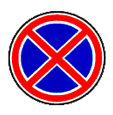 3.27 · No Stopping
Law: Annex 1, sign 3.27 Annex 1, group 3, note 2 Annex 1, group 4, note 1
3 Passing obstacles and roundabouts
5 5 exam questions on this section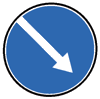 4.2.1 · Pass Obstacle on the Right
 4.2.2 · Pass Obstacle on the Left
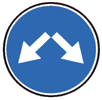 4.2.3 · Pass Obstacle on Either Side
Sign 4.2.1 shows that a dividing strip, safety island or other obstacle is to be passed on the right only. Sign 4.2.2 means on the left only, and sign 4.2.3 on the right or the left.
Law: Annex 1, sign 4.2.1 Annex 1, sign 4.2.2 Annex 1, sign 4.2.3
The sign sets the side. A driver may pass a safety island, a bollard or another device on the carriageway they are driving on, on the right or on the left. If a road sign shows which side to use, the driver must pass on that side, and this goes for every driver, including the driver of a motorcycle. With no sign, an island, bollard or device on the axis of the carriageway of a two-way road must be passed on the right only.
Law: Art. 32 ¶17 ¶17(a) ¶17(b) Annex 1, sign 4.2.1 Annex 1, sign 4.2.2 Annex 1, sign 4.2.3
U-turns go round the island. Sign 4.3 allows traffic in the direction of its arrows at an intersection laid out for roundabout traffic. You may make a U-turn there only along the arrows too, going round the central island. A U-turn against the arrows, without going round the island, is prohibited.
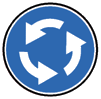 4.3 · Roundabout
Law: Annex 1, sign 4.3
4 Bicycle paths, minimum speed, chains
3 3 exam questions on this sectionSign 4.4 marks a bicycle path: a path meant for cycling and structurally separated from other roads or other parts of the road. It stands as the main sign at the start of the bicycle path and again after each crossing with a road. A bicycle in a red-bordered circle, sign 3.9, means something else: it bans bicycles and mopeds.
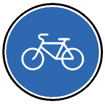 4.4 · Bicycle Path
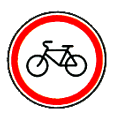 3.9 · No Cycles
Law: Annex 1, sign 4.4 Annex 1, sign 3.9
Minimum speed up to the nearest intersection. Sign 4.6 sets the minimum speed for driving on the road. It applies from the place of the sign to the nearest intersection or, in a populated area with no intersection, to the end of the populated area. Sign 4.7 marks the end of the zone.
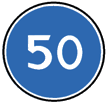 4.6 · Minimum Speed Limit
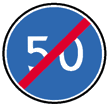 4.7 · End of Minimum Speed Limit Zone
Law: Annex 1, sign 4.6 Annex 1, sign 4.7
Several signs show a speed figure. In a blue circle, sign 4.6, it is the minimum speed. In a red-bordered white circle, sign 3.24, it is the maximum. The blue square, sign 7.2, only shows a recommended speed.
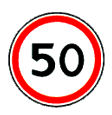 3.24 · Maximum Speed Limit
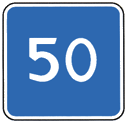 7.2 · Recommended Speed
Law: Annex 1, sign 4.6 Annex 1, sign 3.24 Annex 1, sign 7.2
Chains on at least two driving wheels. On a stretch of road marked with sign 4.8, a vehicle must have snow chains fitted on at least two driving wheels.
 4.8 · Snow Chains Compulsory
Law: Annex 1, sign 4.8
5 Up to the nearest intersection
Sign 4.1.1 placed at the start of a stretch of road and sign 4.6 apply up to the nearest intersection. So do signs of other groups, for example 3.16 and 7.2. In a populated area with no intersection, 3.16 applies to the end of the area, and 7.2 with a warning sign covers the whole hazardous section. Obstacle signs such as 4.2.1 have no such zone: they only show the side on which to pass.
4.1.1 · Straight Ahead Only
4.6 · Minimum Speed Limit
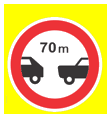 3.16 · Minimum Distance
7.2 · Recommended Speed
4.2.1 · Pass Obstacle on the Right
Law: Annex 1, group 4, note 1 Annex 1, sign 4.6 Annex 1, group 3, note 2 Annex 1, sign 7.2 Annex 1, sign 4.2.1
Key points
- At a direction sign you may go only where the arrows point. A U-turn is allowed only if the sign allows a left turn. Reversing at an intersection is prohibited.
- Direction signs, like the no-right-turn and no-left-turn signs, apply at the crossing of carriageways they stand before. At the next crossing, even within the same intersection, they no longer apply.
- The straight-ahead-only sign at the start of a stretch of road applies up to the nearest intersection, but not at it. It does not prohibit a right turn into a yard; a left turn into a yard is prohibited.
- The sign sets the side for passing an obstacle, for every driver. Obstacle signs have no zone running to the nearest intersection.
- At a roundabout intersection a U-turn goes along the arrows, round the central island.
- The minimum speed sign applies up to the nearest intersection or, in a populated area with none, to its end. On a stretch marked with the snow chains sign, a vehicle must have chains on at least two driving wheels.
Plain-language summary for exam preparation; the law's text prevails.
Now answer this lesson's questions
22 exam questions are about this lesson. A wrong answer comes back until you get it right, and you see which questions are ready for the exam.
Practise the questionsFree account · sign in with e-mail or Google
22 exam questions
Practise the questions