
Lesson 12 of 29 · Signs and markings
Service signs and plates
8 min 35 questions
This lesson covers service signs, which tell you where to find a filling station, first aid or a hotel nearby. Most of it is about plates, the additional information signs. You will learn to read a sign together with its plate: where it starts, how far it reaches, on which days and for which vehicles.
Both kinds of sign are set out in the first annex to the Law of Georgia on Road Traffic. In law a plate is a road sign too: it clarifies or limits the operation of the road sign it is used with. A plate is never used on its own.
Law: Art. 5 ¶16 Annex 1, group 6 Annex 1, group 8
1 Service signs
17 17 exam questions on this sectionService signs inform road users about a facility or service. These road signs are blue rectangles with a white field that shows the facility’s symbol. They only tell the driver where to find fuel, food, rest or help.
Law: Annex 1, group 6
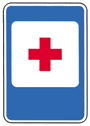 6.1 · First Aid Station
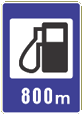 6.2 · Filling Station
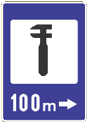 6.3 · Vehicle Technical Service
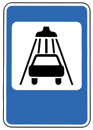 6.4 · Car Wash
Sign 6.1 points to a first aid station. Sign 6.2 points to a filling station, 6.3 to servicing for motor vehicles and 6.4 to washing them.
6.1 · First Aid Station
6.2 · Filling Station
6.3 · Vehicle Technical Service
6.4 · Car Wash
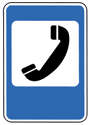 6.5 · Telephone
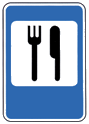 6.6 · Food Service
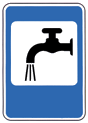 6.7 · Drinking Water
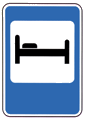 6.8 · Hotel or Motel
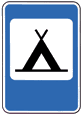 6.9 · Camping
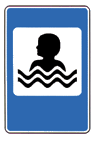 6.16 · Swimming Pool or Beach
Sign 6.5 points to a telephone, 6.6 to a place to eat and 6.7 to drinking water. Sign 6.8 points to a hotel or motel, 6.9 to a campsite and 6.16 to a swimming pool or beach.
6.5 · Telephone
6.6 · Food Service
6.7 · Drinking Water
6.8 · Hotel or Motel
6.9 · Camping
6.16 · Swimming Pool or Beach
Sign 6.11 tells you of a Patrol Police post: its white field carries two Georgian letters. Sign 6.13 points to a checkpoint for international motor transport. It shows a truck and a bus.
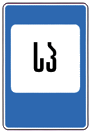 6.11 · Patrol Police Post
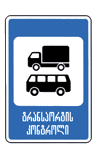 6.13 · International Road Haulage Checkpoint
Two signs concern radio, and they are easy to mix up. Sign 6.14 marks the reception zone of a radio station broadcasting information about road traffic: its white field holds only the Georgian word for radio, with the frequency below. Sign 6.15 marks a zone of radio contact with the emergency services: its white field holds the Georgian word for contact and a frequency, with a channel number below. Both carry a frequency, so tell them apart by the white field: a word alone, or a word with a number.
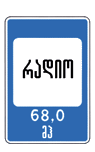 6.14 · Radio Traffic Information Zone
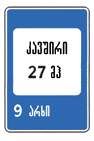 6.15 · Emergency Radio Contact Zone
2 Distance and zone of effect
18 18 exam questions on this sectionPlates, the additional information signs, are white rectangles with a black border that carry a number, an arrow or a picture. As a rule, a plate is placed directly under the sign it is used with. Read the sign and its plate together. The English exam questions often call plates boards.
Law: Art. 5 ¶16 Annex 1, group 8 Annex 1, group 8, note 2
 8.1.1 · Distance to Object
 8.2.1 · Zone of Effect
A distance alone: the sign applies further on. Plate 8.1.1, with a distance alone, gives the distance from the sign to one of three places. These are the start of a dangerous section, the point where a restriction begins, or a certain object ahead in the direction of travel. With this plate the sign takes effect not where it stands but that far ahead.
Law: Annex 1, sign 8.1.1
A number between arrows is a length. On plate 8.2.1 the number stands between two arrows pointing up. Under a warning sign it gives the length of the dangerous section of road. Under a prohibitory or information sign it gives the sign’s zone of effect, which starts where the sign stands.
Law: Annex 1, sign 8.2.1 Annex 1, group 3, note 2
Under the same sign these two plates mean different things. Sign 3.24 prohibits driving faster than the speed shown on it. With plate 8.1.1 the limit begins once you have covered the distance shown. The same number on plate 8.2.1 means the limit applies from the sign itself and over that distance.
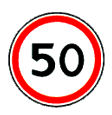 3.24 · Maximum Speed Limit
Law: Annex 1, sign 3.24 Annex 1, group 3, note 2 Annex 1, sign 8.1.1 Annex 1, sign 8.2.1
Most warning signs stand not at the dangerous section itself but before it. Outside a populated area such a sign stands 150–300 metres before the start of the dangerous section, and in a populated area 50–100 metres before it. If the sign has to stand at another distance, plate 8.1.1 gives that distance. More on this in the lesson on warning signs.
Law: Annex 1, group 1, note 1 Annex 1, sign 8.1.1
Outside a populated area you see an Uneven Road sign with plate 8.2.1 under it, a number between arrows. The uneven stretch of road begins 150–300 metres after the sign. The number on the plate is not that distance but the length of the stretch itself.
A narrow section at the distance shown. Plate 8.1.1 works the same way with priority signs. Under sign 2.5, entering a narrow section of road is prohibited if that would hinder traffic coming the other way. The driver must give way to oncoming vehicles on the narrow section or at its far approach. With plate 8.1.1, the narrow section and these rules begin at the distance shown.
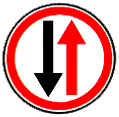 2.5 · Priority of Oncoming Traffic
Law: Annex 1, sign 2.5 Annex 1, sign 8.1.1
3 Arrows on plates
 8.2.2 · Zone of Effect
 8.2.3 · Zone of Effect
 8.2.4 · Zone of Effect
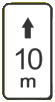
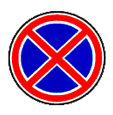
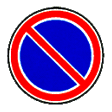
The zone of a stopping or parking ban. Three plates with a vertical arrow go with signs 3.27–3.30, such as 3.27 and 3.28. Plate 8.2.2, with an arrow pointing up and a number, shows the zone of effect of these signs. Plate 8.2.3, with an arrow pointing down, shows where that zone ends. Plate 8.2.4, with a double arrow, tells the driver that they are inside the zone.
 3.27 · No Stopping
 3.28 · No Parking
Law: Annex 1, sign 8.2.2 Annex 1, sign 8.2.3 Annex 1, sign 8.2.4
 8.1.3 · Distance to Object
 8.1.4 · Distance to Object
 8.2.5 · Zone of Effect
 8.2.6 · Zone of Effect
An object off the road, or a zone along a building. Plates 8.1.3 and 8.1.4 give the distance to an object that lies off the road, away to one side. Plates 8.2.5 and 8.2.6 look similar but show the zone of effect of signs 3.27–3.30. That is a zone with no stopping or parking along one side of a square, a building front and the like. On their own, the pairs differ by the figures, which are bold on 8.2.5 and 8.2.6; under a sign, the sign tells them apart too.
Law: Annex 1, sign 8.1.3 Annex 1, sign 8.1.4 Annex 1, sign 8.2.5 Annex 1, sign 8.2.6
 8.3.1 · Direction of Effect
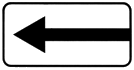 8.3.2 · Direction of Effect
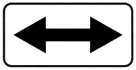 8.3.3 · Direction of Effect
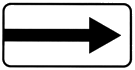
A horizontal arrow with no number is a direction. Plates 8.3.1, 8.3.2 and 8.3.3 show a horizontal arrow with no number. They give the direction in which a sign placed before an intersection applies, or the way to a marked facility right by the road. The double arrow is horizontal on 8.3.3 but vertical on 8.2.4, which tells the driver they are inside the zone of signs 3.27–3.30.
Law: Annex 1, sign 8.3.1 Annex 1, sign 8.3.2 Annex 1, sign 8.3.3 Annex 1, sign 8.2.4
Plate 8.13 shows the direction of the main road at an intersection, that is, which road keeps priority. It goes with signs 2.1, 2.3 and 2.4 when the main road changes direction at the intersection. More on this in the lesson on priority signs.
 8.13 · Direction of Main Road
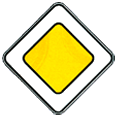 2.1 · Main Road
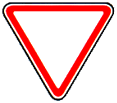 2.3 · Yield (Give Way)
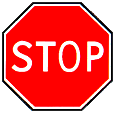 2.4 · No Entry Without Stopping
Law: Annex 1, sign 8.13
4 When a sign applies
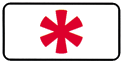 8.5.1 · Saturday, Sunday and Holidays
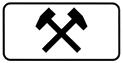 8.5.2 · Working Days
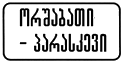 8.5.3 · Days of the Week
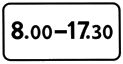 8.5.4 · Time of Effect
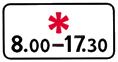 8.5.5 · Time of Effect
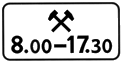 8.5.6 · Time of Effect
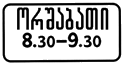 8.5.7 · Time of Effect
Days of the week or time of day. Plates 8.5.1, 8.5.2 and 8.5.3 give the days of the week on which a sign applies. A red asterisk means Saturdays, Sundays and holidays, crossed hammers mean working days, and plate 8.5.3 names the days in words. Plate 8.5.4 gives only the time of day when the sign applies.
Law: Annex 1, sign 8.5.1 Annex 1, sign 8.5.2 Annex 1, sign 8.5.3 Annex 1, sign 8.5.4
Days together with hours. Plates 8.5.5, 8.5.6 and 8.5.7 give both the days of the week and the time of day when the sign applies. The symbol or words above the hours name the days just as on plates 8.5.1–8.5.3. So only plate 8.5.4, with hours alone, gives no days of the week.
Law: Annex 1, sign 8.5.1 Annex 1, sign 8.5.3 Annex 1, sign 8.5.5 Annex 1, sign 8.5.6 Annex 1, sign 8.5.7 Annex 1, sign 8.5.4
You want to park where a No Parking sign has a plate with crossed hammers and hours under it. Parking here is prohibited only on working days and only during the hours shown. On Saturdays, Sundays and holidays the sign does not apply, nor on working days outside those hours.
Wet surface. Plate 8.16 means that the sign applies during the time when the surface of the carriageway is wet. It is used with signs 1.16, 3.20, 3.22 and 3.24.
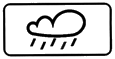 8.16 · Wet Surface
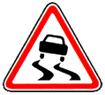 1.16 · Slippery Road
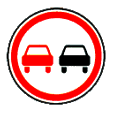 3.20 · No Overtaking
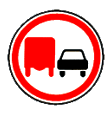 3.22 · No Overtaking by Goods Vehicles
3.24 · Maximum Speed Limit
Law: Annex 1, sign 8.16
5 Which vehicles a sign covers
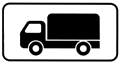 8.4.1 · Vehicle Type
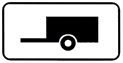 8.4.2 · Vehicle Type
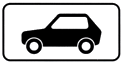 8.4.3 · Vehicle Type
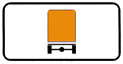 8.4.8 · Vehicle Type
Vehicle type plates show the type of vehicle the sign applies to. With plate 8.4.1 it covers trucks, with or without a trailer, whose maximum permissible mass exceeds 3.5 tonnes. With 8.4.2 it covers trucks and tractors with any kind of trailer or semi-trailer, and vehicles towing a mechanical vehicle. With 8.4.3 it covers passenger cars, and with 8.4.8 vehicles bearing the dangerous cargo identification sign. The English exam questions often call passenger cars light vehicles.
Law: Annex 1, sign 8.4.1 Annex 1, group 8, note 1
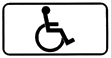 8.17 · Person with a Disability
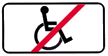 8.18 · Except Persons with a Disability
The symbol, plain or crossed out. Plate 8.17 means that sign 7.4 applies to vehicles bearing the identification sign for persons with disabilities. Plate 8.18, with the symbol crossed out, means the opposite: the sign does not apply to vehicles bearing that identification sign. For every other vehicle the sign applies as usual. The identification sign carries the same symbol as plate 8.17: a person in a wheelchair.
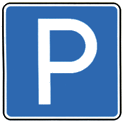 7.4 · Parking Place
Law: Annex 1, sign 8.17 Annex 1, sign 8.18
Before an intersection you see a Straight Ahead Only sign with plate 8.18 under it. The sign allows traffic to go straight ahead only. The driver of a car without the identification sign for persons with disabilities has to go straight on. For a car bearing that identification sign, the sign does not apply.
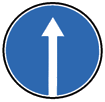 4.1.1 · Straight Ahead Only
Key points
- Service signs only inform. The sign whose white field holds only the word for radio marks a traffic radio reception zone. The sign with the word for contact and a channel number marks a zone of radio contact with the emergency services.
- A distance alone on a plate is how far ahead the sign takes effect. A number between arrows is the length of the dangerous section, or the sign’s zone of effect starting at the sign.
- Most warning signs stand 150–300 metres before the dangerous section outside a populated area, and 50–100 metres before it in a populated area.
- Plates with a single vertical arrow concern the zone of signs banning stopping or parking. A horizontal arrow with no number is the direction in which the sign applies. A sideways arrow with a number is the distance to an object off the road; with bold figures it is a no-stopping or no-parking zone along a square or building.
- Every plate that shows days, by a symbol or in words, gives days of the week, while a plate with hours alone gives only the time of day. With the Wet Surface plate, the sign applies while the carriageway surface is wet.
- With a plate showing a passenger car, the sign applies to passenger cars; with one showing a truck, to trucks whose maximum permissible mass exceeds 3.5 tonnes. With the crossed-out symbol, the sign does not apply to vehicles bearing the identification sign for persons with disabilities.
Plain-language summary for exam preparation; the law's text prevails.
Now answer this lesson's questions
35 exam questions are about this lesson. A wrong answer comes back until you get it right, and you see which questions are ready for the exam.
Practise the questionsFree account · sign in with e-mail or Google
The law behind this lesson
35 exam questions
Practise the questions