
Lesson 13 of 29 · Signs and markings
Road markings
7 min 12 questions
This lesson covers what the lines, arrows and legends on the carriageway mean, which lines you may cross, and what the yellow lines and the stop line mark. The last section is about vertical markings on bridges and tunnels.
A road marking is a line, arrow or other marking on the carriageway, on road equipment or on road structures. It sets the rules of movement or tells road users about the traffic regime. Annex 2 to the law sorts markings into two groups: horizontal ones on the carriageway, and vertical ones on structures and road equipment.
Law: Art. 5 ¶59 Annex 2 Annex 2, group 1 Annex 2, group 2
1 Solid and broken lines
11 11 exam questions on this sectionHorizontal markings on the carriageway are white, except the yellow lines 1.4, 1.10 and 1.17 and the red marking 1.28. Most lines along the road separate traffic flows or lanes. First of all, look at whether a line is solid or broken. The English exam questions often call the carriageway the driveway.
Law: Annex 2, group 1 Annex 2, marking 1.1 Annex 2, marking 1.5
Solid line 1.1 separates traffic flows going in opposite directions. At dangerous places on the road it marks the edges of lanes, including between lanes going the same way, or edges of the carriageway that must not be entered. The same line marks the edges of parking spaces for vehicles and the edge of the carriageway on roads that by traffic conditions do not count as a motorway. Line 1.3 separates opposite flows on roads with four lanes or more.
 1.1 · Solid Line
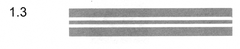 1.3 · Double Solid Line
Law: Annex 2, marking 1.1 Annex 2, marking 1.3
No crossing a solid line. Crossing lines 1.1 and 1.3 is prohibited. That includes a line 1.1 between lanes going the same way: you may not cross it for a lane change, for overtaking or for a bypass. The only line 1.1 a driver may cross is one that marks the edge of the carriageway on the right, to stop the vehicle on the shoulder of the road.
Law: Annex 2, marking 1.1 Annex 2, marking 1.3
On a dangerous stretch of road, the two lanes going your way are separated by a solid line 1.1. Your right lane is taken and the left one is free. Moving into the left lane would mean crossing line 1.1, so you stay in your lane.
Crossing a broken line from either side. Broken line 1.5 separates traffic flows going in opposite directions on roads with two or three lanes. Where two or more lanes go the same way, it marks the edges between them. Line 1.5 may be crossed from either side.
 1.5 · Broken Line
Law: Annex 2, marking 1.5
Lanes inside an intersection. Line 1.7, a broken line with short dashes and equal gaps, marks lanes within an intersection. Line 1.7 may be crossed from either side. So line 1.7 by itself limits no direction: directions are limited by road signs or by the lane arrows of road marking 1.18. Where there are none, the 1.7 lines do not stop a driver from going straight on, turning or making a U-turn.
 1.7 · Short-Stroke Broken Line
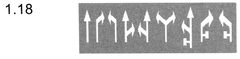 1.18 · Lane Direction Arrows
Law: Annex 2, marking 1.7 Annex 2, marking 1.18
Signs override markings. If road signs and road markings contradict each other, the driver must follow the signs. This includes temporary signs on portable stands. More on this in the lesson on traffic lights.
Law: Annex 2 Art. 28 ¶4
2 Double lines 1.11 and 1.9
Both of these lines are double. Line 1.11 is a solid line and a broken line side by side, and the rule depends on which of the two is nearer the driver. Line 1.9 is a double broken line. It is used on roads with reversible traffic control.
 1.11 · Solid Line Beside a Broken One
 1.9 · Reversible Lane Line
Law: Annex 2, marking 1.11 Annex 2, marking 1.9
Line 1.11: from which side. Line 1.11 separates flows going in opposite directions, or the same direction, on sections of road where changing lanes is allowed from one lane only. Places for U-turns, for entering and leaving car parks and the like, where traffic may go one way only, are marked with it too. Line 1.11 may be crossed from the broken side, and from the solid side only on completing an overtaking or a bypass.
Law: Annex 2, marking 1.11
You want to make a U-turn, and the solid line of 1.11 is the one nearer you. A U-turn does not complete an overtaking or a bypass, so you may not cross here. A driver on the other side has the broken line nearer and may cross it.
Reversible lanes. Line 1.9 marks the edges of lanes with reversible traffic control. With no reversible lights, or with them off, a driver may cross a line 1.9 on the right; with them off, crossing a line 1.9 between opposite flows is prohibited. With the reversible lights on, the driver may cross a line 1.9 between lanes going one way from either side. When the reversible traffic lights switch off, the driver must at once move right, beyond line 1.9.
Law: Annex 2, marking 1.9
3 Yellow markings
The yellow lines 1.4, 1.10 and 1.17 have to do with stopping and parking. Lines 1.4 and 1.10 are drawn at the edge of the carriageway or along the top of the kerb.
Law: Annex 2, group 1 Annex 2, marking 1.4 Annex 2, marking 1.10 Annex 2, marking 1.17
Yellow lines 1.4 and 1.10 ban stopping or parking. Solid yellow line 1.4 marks places where stopping is prohibited. It is used on its own or together with the No Stopping sign 3.27. Broken yellow line 1.10 marks places where parking is prohibited. It too is used on its own or with the No Parking sign 3.28.
 1.4 · Yellow Solid Line
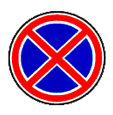 3.27 · No Stopping
 1.10 · Yellow Broken Line
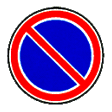 3.28 · No Parking
Law: Annex 2, marking 1.4 Annex 2, marking 1.10 Annex 1, sign 3.27 Annex 1, sign 3.28
Dropping off a passenger is stopping too. Stopping means intentionally halting a vehicle for up to 5 minutes, or longer if needed for passengers to get in or out or for loading or unloading. So at a solid yellow line 1.4 you may not stop even briefly to let a passenger out. More on this in the lesson on stopping and parking.
Law: Art. 5 ¶11 Annex 2, marking 1.4
Yellow line 1.17 marks the stopping places of route vehicles and the parking places of taxis. Marking 1.23, a legend on the carriageway, marks a lane intended for the movement of route vehicles. The marking that sets it apart may be yellow.
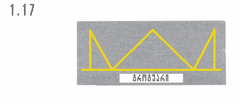 1.17 · Yellow Stop-Bay Line
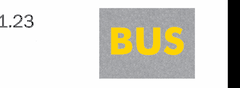 1.23 · Route-Service Lane
Law: Annex 2, marking 1.17 Annex 2, marking 1.23
4 Transverse lines, arrows and legends
Not every marking runs along the road. Transverse lines 1.12 and 1.13 mark the driver’s stopping place, and marking 1.15 the place where a bicycle path crosses the carriageway. The English exam questions often call transverse markings lateral markings.
Law: Annex 2, marking 1.12 Annex 2, marking 1.13 Annex 2, marking 1.15
Stopping at the stop line and the give-way line. Stop line 1.12 shows where the driver must stop at a prohibiting signal of a traffic light or a traffic controller. Where the No Entry Without Stopping sign 2.4 stands, the driver must stop before the stop line. Give-way line 1.13 shows where the driver must stop if necessary, to give way to vehicles on the road being crossed.
 1.12 · Stop Line
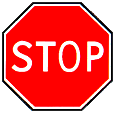 2.4 · No Entry Without Stopping
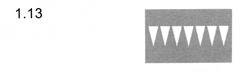 1.13 · Give-Way Line
Law: Annex 2, marking 1.12 Annex 1, sign 2.4 Annex 2, marking 1.13
Marking 1.15 marks the place where a bicycle path crosses the carriageway.
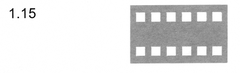 1.15 · Cycle Track Crossing
Law: Annex 2, marking 1.15
Arrow 1.19 warns that the carriageway narrows ahead, that the number of lanes in this direction drops, or that a marking 1.1 or 1.11 between opposite flows is coming up.
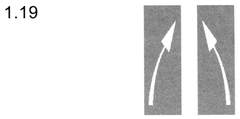 1.19 · Narrowing Warning
Law: Annex 2, marking 1.19
A legend on the carriageway, letters and numbers 1.22, gives the road (route) number.
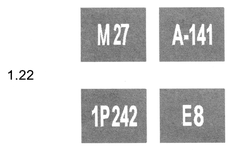 1.22 · Road (Route) Number
Law: Annex 2, marking 1.22
5 Vertical markings
1 1 exam question on this sectionVertical markings are combinations of black and white stripes. They are put on bridge supports, the end faces of tunnel portals, fences, parapets, kerbs and other road equipment. Their purpose is to help road users see these things.
Law: Annex 2, group 2
A low structure over the carriageway. Marking 2.2 shows the lower edge of a tunnel, bridge, overpass or other structure. It is used on structures less than 5 metres above the carriageway that the carriageway passes wholly or partly under.
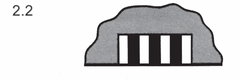 2.2 · Low Structure Edge
Law: Annex 2, marking 2.2
Key points
- Solid lines 1.1 and 1.3 must not be crossed, including a line 1.1 between lanes going the same way. Only a line 1.1 on your right that marks the edge of the carriageway may be crossed, to stop on the shoulder. Broken lines 1.5 and 1.7 may be crossed from either side, and line 1.7 by itself limits no direction at an intersection.
- Line 1.11 may be crossed from the broken side, and from the solid side only on completing an overtaking or a bypass. The double broken line 1.9 marks the edges of lanes with reversible traffic control.
- Solid yellow line 1.4 marks places where stopping is prohibited, including to let a passenger out. Broken yellow line 1.10 marks places where parking is prohibited.
- Yellow line 1.17 marks the stopping places of route vehicles and the parking places of taxis. Marking 1.23, a legend on the carriageway, shows a lane for route vehicles.
- The stop line is where the driver must stop at a prohibiting signal. If a sign and a marking contradict each other, the driver must follow the sign.
- Marking 1.15 shows where a bicycle path crosses the carriageway, arrow 1.19 warns that the carriageway narrows or loses a lane, and legend 1.22 gives the road (route) number. Vertical marking 2.2 shows the lower edge of a structure less than 5 metres above the carriageway that the carriageway passes under.
Plain-language summary for exam preparation; the law's text prevails.
Now answer this lesson's questions
12 exam questions are about this lesson. A wrong answer comes back until you get it right, and you see which questions are ready for the exam.
Practise the questionsFree account · sign in with e-mail or Google
The law behind this lesson
12 exam questions
Practise the questions