
Lesson 9 of 29 · Signs and markings
Prohibitory signs
11 min 55 questions
This lesson covers prohibitory signs: what each of them prohibits and whom it does not apply to. It also covers where a sign stops applying: at the nearest intersection, at the end of a populated area, or where a marking line ends.
A prohibitory sign restricts traffic or lifts a restriction. These signs are set out in the first annex to the Law of Georgia on Road Traffic.
Law: Annex 1, group 3
1 Bans on entry and traffic
48 48 exam questions on this section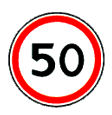 3.24 · Maximum Speed Limit
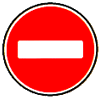 3.1 · No Entry
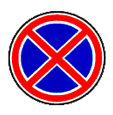 3.27 · No Stopping
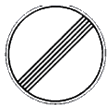 3.31 · End of All Restrictions
As the drawings show, a prohibitory sign is usually a white circle with a red border, like 3.24. Sign 3.1 is a red circle with a white bar, and the signs banning stopping and parking are blue circles with a red border, like 3.27. End-of-zone signs are white circles without a red border, crossed by black diagonal stripes, like 3.31. Signs 3.16, 3.20, 3.22, 3.24 and 3.26–3.30 apply from the place where they stand.
Law: Annex 1, group 3 Annex 1, group 3, note 2
No entry in one direction, no traffic in either. Under sign 3.1, entry by all kinds of vehicles in the given direction is prohibited. Sign 3.2 prohibits all kinds of vehicles from moving, in both directions.
3.1 · No Entry
 3.2 · No Vehicles
Law: Annex 1, sign 3.1 Annex 1, sign 3.2 Annex 1, group 3, note 2
One kind of vehicle. Under sign 3.3, all mechanical vehicles are prohibited from moving; under 3.5, motorcycles of every kind. Sign 3.6 does the same for tractors of every kind and specialized self-propelled machines, and 3.9 for bicycles and mopeds. Like 3.2, these signs ban traffic in both directions.
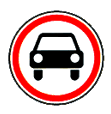 3.3 · No Motor Vehicles
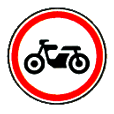 3.5 · No Motorcycles
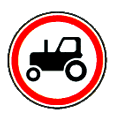 3.6 · No Tractors
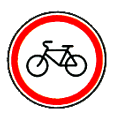 3.9 · No Cycles
Law: Annex 1, sign 3.3 Annex 1, sign 3.5 Annex 1, sign 3.6 Annex 1, sign 3.9 Annex 1, group 3, note 2
Sign 3.2 bans every kind of vehicle, so it also covers those that other signs, such as 3.3 or 3.5, name separately. Several signs can apply to one vehicle at once. A truck with a trailer, for example, is banned by 3.3, 3.7 and 3.2 alike.
Law: Annex 1, sign 3.2 Annex 1, sign 3.3 Annex 1, sign 3.5 Annex 1, sign 3.7
Trailers and towing. Sign 3.7 prohibits trucks with trailers and tractors with trailers of any type from moving. Towing mechanical vehicles, such as another passenger car or a motorcycle, is prohibited too.
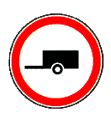 3.7 · No Vehicles with Trailer
Law: Annex 1, sign 3.7
Permissible mass or actual mass. Under sign 3.4, vehicles and combinations of vehicles whose maximum permissible mass exceeds the figure on the sign are prohibited. Under sign 3.11, the same applies when their total actual mass is above the figure on the sign. Maximum permissible mass is the largest mass of the loaded vehicle declared permissible, so its actual mass must not exceed it. A truck and the vehicle it tows form a combination that takes part in traffic as one unit.
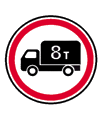 3.4 · No Goods Vehicles
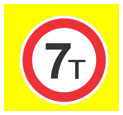 3.11 · Mass Limit
Law: Annex 1, sign 3.4 Annex 1, sign 3.11 Art. 5 ¶52 ¶74
Height and width, with or without a load. Under sign 3.13, vehicles whose overall height, with or without a load, exceeds the figure on the sign are prohibited. Under sign 3.14, the same applies to overall width, with or without a load.
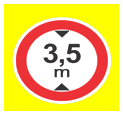 3.13 · Height Limit
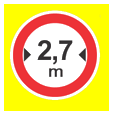 3.14 · Width Limit
Law: Annex 1, sign 3.13 Annex 1, sign 3.14
Dangerous cargo. Under sign 3.32, vehicles carrying dangerous cargo that Georgian law requires to bear an identification sign are prohibited. Sign 3.33 prohibits vehicles with explosive and highly flammable cargo of classes 1.22–2.4, 3.1, 3.2, 5.2 under state standard 19433-88 that must bear the identification sign for dangerous cargo. The first covers any dangerous cargo that needs an identification sign, the second only explosive and highly flammable cargo of those classes.
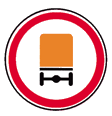 3.32 · No Vehicles Carrying Dangerous Goods
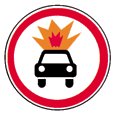 3.33 · No Vehicles Carrying Explosives or Flammable Goods
Law: Annex 1, sign 3.32 Annex 1, sign 3.33
Animals and pedestrians. Under sign 3.8, animal-drawn transport and pack and riding animals are prohibited, and so is driving livestock. Sign 3.10 prohibits pedestrians; it is placed where walking is not allowed for their own safety.
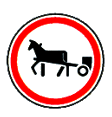 3.8 · No Animal-Drawn Vehicles
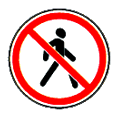 3.10 · No Pedestrians
Law: Annex 1, sign 3.8 Annex 1, sign 3.10
2 What is banned on the way
Customs, danger, control. Under sign 3.17.1, you must not pass a customs checkpoint (the customs control zone at Georgia’s customs border) without coming to a halt. Under sign 3.17.3, the same is prohibited at other control points. They include, for example, a police or quarantine post, the entry to a border or closed zone and the way onto a toll road. Under sign 3.17.2, all kinds of vehicles are prohibited from going further because of a road traffic accident or another danger.
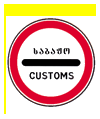 3.17.1 · Customs
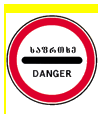 3.17.2 · Danger
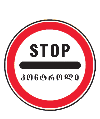 3.17.3 · Control
Law: Annex 1, sign 3.17.1 Annex 1, sign 3.17.2 Annex 1, sign 3.17.3
Turn bans at the nearest crossing. Past signs 3.18.1 and 3.18.2, you must not turn right or left respectively at the nearest crossing of carriageways. Under sign 3.19, a U-turn is prohibited there. Signs 3.18.1 and 3.18.2 apply at the crossing of carriageways in front of which they stand.
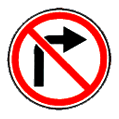 3.18.1 · No Right Turn
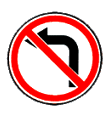 3.18.2 · No Left Turn
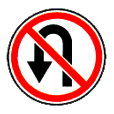 3.19 · No U-Turn
Law: Annex 1, sign 3.18.1 Annex 1, sign 3.18.2 Annex 1, sign 3.19 Annex 1, group 3, note 2
So such a sign no longer applies at later crossings. Mandatory signs 4.1.1–4.1.6 work the same way: they too apply at the crossing of carriageways in front of which they stand. The notes give no such rule for sign 3.1. More on this in the lesson on mandatory signs.
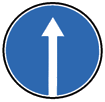 4.1.1 · Straight Ahead Only
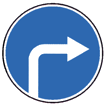 4.1.2 · Right Turn Only
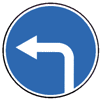 4.1.3 · Left Turn Only
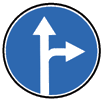 4.1.4 · Straight or Right
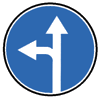 4.1.5 · Straight or Left
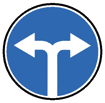 4.1.6 · Right or Left
Law: Annex 1, group 3, note 2 Annex 1, group 4, note 1
What may not be overtaken. Overtaking any mechanical vehicle is prohibited in the zone of sign 3.20, except one moving at less than 30 km/h. You may overtake a motorcycle without a sidecar, a moped or a bicycle, as long as you do not move over to where oncoming traffic drives.
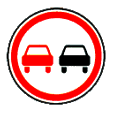 3.20 · No Overtaking
Law: Annex 1, sign 3.20
You have passed sign 3.20, and a truck ahead is crawling uphill at less than 30 km/h. This sign does not stop you overtaking it: it does not cover such slow traffic.
Towing a motorcycle, overtaking a towing vehicle. A motorcycle without a sidecar, that is without a side trailer, must not tow, and must not be towed. A towing vehicle is still a mechanical vehicle, so in the zone of sign 3.20 you must not overtake it unless it moves at less than 30 km/h.
Law: Art. 45 ¶6 ¶6(d) Annex 1, sign 3.20
A speed limit and its end. Past sign 3.24 you must not drive faster than the figure on the sign (km/h). Sign 3.25 marks the end of the zone of sign 3.24. It sets no speed of its own and has nothing to do with a minimum speed.
3.24 · Maximum Speed Limit
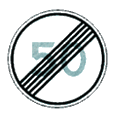 3.25 · End of Maximum Speed Limit
Law: Annex 1, sign 3.24 Annex 1, sign 3.25
The horn only to prevent an accident. In the zone of sign 3.26 you must not use the horn, except to prevent a road traffic accident.
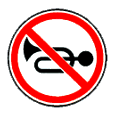 3.26 · No Sounding of Horn
Law: Annex 1, sign 3.26
3 Stopping and parking
1 1 exam question on this sectionStopping means deliberately halting a vehicle for up to 5 minutes, or longer if passengers need to get in or out or the vehicle needs loading or unloading. A deliberate halt in the traffic flow is not stopping if technical means of organization of road traffic or a traffic controller require it. Parking means deliberately halting for more than 5 minutes when it is not needed for those purposes.
Law: Art. 5 ¶11 ¶20
A cross bans stopping as well. Under sign 3.27, both stopping and parking of vehicles are prohibited, and under sign 3.28 only parking; sign 3.27 does not apply to route vehicles. They are easy to tell apart: sign 3.27 has a red cross, sign 3.28 a single red diagonal stripe. Sign 3.28 does not apply to a postal motor vehicle whose body has a white diagonal stripe on a blue background, or to a taxi with its taximeter on. Nor does it apply to a vehicle driven by a person with the status of a significant or severe disability, or to a vehicle carrying such persons.
3.27 · No Stopping
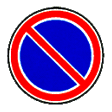 3.28 · No Parking
Law: Annex 1, sign 3.27 Annex 1, sign 3.28 Annex 1, group 3, note 2
Odd and even days. Under sign 3.29, parking of vehicles is prohibited on odd days of the month, and under sign 3.30 on even days. Signs 3.29 and 3.30 do not apply to a postal motor vehicle whose body has a white diagonal stripe on a blue background. They also do not apply to a taxi with its taximeter on. Nor do they apply to a vehicle driven by a person with the status of a significant or severe disability, or to a vehicle carrying such persons.
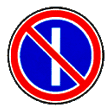 3.29 · No Parking on Odd-Numbered Days
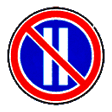 3.30 · No Parking on Even-Numbered Days
Law: Annex 1, sign 3.29 Annex 1, sign 3.30 Annex 1, group 3, note 2
Time to move across. When signs 3.29 and 3.30 are used together, the time from 19 to 21 hours is set aside for moving vehicles from one side of the road to the other. For example, sign 3.29 stands on one side of the street and 3.30 on the other. During that time you may use both sides of the carriageway for parking, whatever the day of the month.
Law: Annex 1, group 3, note 1
4 Where a sign stops applying
6 6 exam questions on this sectionUp to the nearest intersection. Signs 3.16, 3.20, 3.22, 3.24 and 3.26–3.30 apply from where the sign stands to the nearest intersection after it. In a populated area with no intersection, they apply to the end of the populated area. Signs that close the road, such as 3.2, are not on this list.
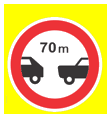 3.16 · Minimum Distance
3.20 · No Overtaking
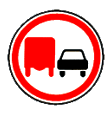 3.22 · No Overtaking by Goods Vehicles
3.24 · Maximum Speed Limit
3.26 · No Sounding of Horn
3.27 · No Stopping
3.28 · No Parking
3.29 · No Parking on Odd-Numbered Days
3.30 · No Parking on Even-Numbered Days
Law: Annex 1, group 3 Annex 1, group 3, note 2
Exits and unsigned minor roads do not end the zone. These signs keep applying past exits from adjacent territories, and past junctions with field, forest and other secondary roads that have no corresponding signs. An exit from an adjacent territory, such as a yard, car park or filling station, does not count as an intersection. An intersection is a crossing, junction or fork of roads on one level, so an overpass above the road does not end the zone.
Law: Annex 1, group 3, note 2 Art. 5 ¶13 ¶38
The populated-area sign does not end the zone. The beginning-of-populated-area sign 5.23.1 does not end such a zone by itself: these signs, placed before it, keep applying beyond it up to the nearest intersection. There is one exception: sign 3.24 placed before a populated area applies up to sign 5.23.1 or 5.23.2. A sign inside a populated area with no intersection ahead stops applying at 5.24.1, at the end of the populated area.
 5.23.1 · Beginning of Built-up Area
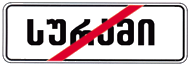 5.24.1 · End of Built-up Area
Law: Annex 1, group 3, note 2 Annex 1, sign 5.23.1 Annex 1, sign 5.24.1
End-of-zone signs. Sign 3.21 marks the end of the zone of 3.20, 3.23 that of 3.22, and 3.25 that of 3.24. Sign 3.21 shows two passenger cars crossed out, while the similar sign 3.23 shows a truck and a passenger car. Sign 3.31 ends the zones of several of signs 3.16, 3.20, 3.22, 3.24 and 3.26–3.30 at once. Plate 8.2.1 shortens the zone of signs 3.16, 3.20, 3.22, 3.24 and 3.26, and a 3.24 with another speed ends the old 3.24.
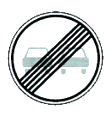 3.21 · End of No Overtaking
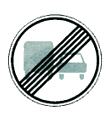 3.23 · End of No Overtaking by Goods Vehicles
3.25 · End of Maximum Speed Limit
3.31 · End of All Restrictions
 8.2.1 · Zone of Effect
Law: Annex 1, sign 3.21 Annex 1, sign 3.23 Annex 1, sign 3.25 Annex 1, sign 3.31 Annex 1, group 3, note 2 Annex 1, sign 8.2.1
The zone of stopping and parking bans. Sign 3.27 can be combined with marking 1.4, and sign 3.28 with marking 1.10; the zone then runs the length of the marking line. The zone of signs 3.27–3.30 is shortened by a repeated sign with plate 8.2.3 at its end, or by plate 8.2.2. Sign 7.4 (Parking Place) with plate 8.2.1 at the end of the zone shortens it too.
 1.4 · Yellow Solid Line
 1.10 · Yellow Broken Line
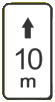 8.2.2 · Zone of Effect
 8.2.3 · Zone of Effect
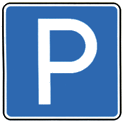 7.4 · Parking Place
Law: Annex 1, group 3, note 2 Annex 2, marking 1.4 Annex 2, marking 1.10 Annex 1, sign 8.2.2 Annex 1, sign 8.2.3 Annex 1, sign 7.4
Only the side where the sign stands. Signs 3.10 and 3.27–3.30 apply only to the side of the road on which they stand.
3.10 · No Pedestrians
3.27 · No Stopping
3.28 · No Parking
3.29 · No Parking on Odd-Numbered Days
3.30 · No Parking on Even-Numbered Days
Law: Annex 1, group 3, note 2
You are driving outside a populated area and see sign 3.27 on the right of the road. A little further on a populated area begins, with no intersection before it. You must not stop on the right either before sign 5.23.1 or after it, all the way to the nearest intersection. On the left this sign does not prohibit stopping.
5 Whom the signs do not apply to
The notes to the prohibitory signs name whom some of them do not apply to. Each exemption covers only an exact list of signs.
Law: Annex 1, group 3, note 2
Route vehicles. Signs 3.1–3.3, 3.18.1, 3.18.2, 3.19 and 3.27 do not apply to route vehicles. A route vehicle is a vehicle meant for carrying passengers by road and running on a set route. Signs limiting mass, height, width, length, distance or speed are not on this list, and neither are signs 3.28–3.30.
3.1 · No Entry
3.2 · No Vehicles
3.3 · No Motor Vehicles
3.18.1 · No Right Turn
3.18.2 · No Left Turn
3.19 · No U-Turn
3.27 · No Stopping
Law: Annex 1, group 3 Annex 1, group 3, note 2 Art. 5 ¶67
Businesses, residents and workers of the zone. Signs 3.2–3.8 do not apply to vehicles serving an enterprise in the sign’s zone. Nor do they apply to vehicles serving or owned by people who live or work in that zone. Such a vehicle enters and leaves the zone at the nearest intersection in the direction of its destination. Signs 3.1 and 3.9, the turn and U-turn signs and the signs for dangerous cargo 3.32 and 3.33 still apply to such vehicles.
3.2 · No Vehicles
3.3 · No Motor Vehicles
3.4 · No Goods Vehicles
3.5 · No Motorcycles
3.6 · No Tractors
3.7 · No Vehicles with Trailer
3.8 · No Animal-Drawn Vehicles
Law: Annex 1, group 3 Annex 1, group 3, note 2
People with disabilities. Signs 3.2, 3.3 and 3.28–3.30 do not apply to vehicles driven by a person with the status of a significant or severe disability. Nor do they apply to vehicles carrying such persons. The speed limit sign 3.24 and sign 3.27 still apply to them.
3.2 · No Vehicles
3.3 · No Motor Vehicles
3.28 · No Parking
3.29 · No Parking on Odd-Numbered Days
3.30 · No Parking on Even-Numbered Days
Law: Annex 1, group 3 Annex 1, group 3, note 2
Key points
- Sign 3.1 bans entry in the given direction, 3.2 the movement of all vehicles in both directions. Signs 3.3, 3.5, 3.6 and 3.9 close the road to one kind of vehicle, and 3.7 to trucks and tractors with trailers and to towing mechanical vehicles.
- Sign 3.20 does not ban overtaking traffic that moves at less than 30 km/h. Nor does it ban overtaking a motorcycle without a sidecar, a moped or a bicycle without moving over to where oncoming traffic drives.
- Sign 3.27 bans both stopping and parking, sign 3.28 only parking. When 3.29 and 3.30 are used together, parking is allowed on both sides of the carriageway from 19 to 21 hours.
- Signs 3.16, 3.20, 3.22, 3.24, 3.26–3.30 apply up to the nearest intersection, or in a populated area with no intersection, to its end. An exit from an adjacent territory or a minor road without signs does not break this zone.
- Signs 3.10 and 3.27–3.30 apply only on the side of the road where they stand. If sign 3.27 or 3.28 comes with a marking, the zone runs the length of its line.
- Signs 3.1–3.3, 3.18.1, 3.18.2, 3.19 and 3.27 do not apply to route vehicles. Signs 3.2–3.8 do not apply to vehicles serving a business in the zone, or serving or owned by people who live or work there. Signs 3.2, 3.3 and 3.28–3.30 do not apply to a vehicle driven by, or carrying, a person with a significant or severe disability.
Plain-language summary for exam preparation; the law's text prevails.
Now answer this lesson's questions
55 exam questions are about this lesson. A wrong answer comes back until you get it right, and you see which questions are ready for the exam.
Practise the questionsFree account · sign in with e-mail or Google
55 exam questions
Practise the questions