
Lesson 8 of 29 · Signs and markings
Priority signs
5 min 15 questions
This lesson covers the priority signs and how to tell them apart by their shape. It also covers which signs give priority at an intersection, where giving way or stopping first is required, and who goes first through a narrow section of road.
Priority signs set the order of passing through intersections, crossings of carriageways and narrow sections of road. The signals of a traffic light or a traffic controller override these signs.
Law: Annex 1, group 2 Art. 28 ¶2 ¶3
1 Priority signs are told apart by shape
15 15 exam questions on this section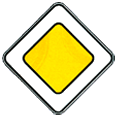 2.1 · Main Road
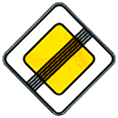 2.2 · End of Main Road
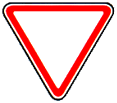 2.3 · Yield (Give Way)
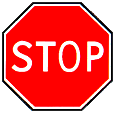 2.4 · No Entry Without Stopping
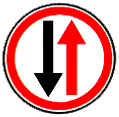 2.5 · Priority of Oncoming Traffic
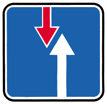 2.6 · Priority over Oncoming Traffic
Unlike warning signs, priority signs share no common shape: almost every one has its own. 2.1 is a yellow diamond in a white frame, and 2.2 is the same diamond crossed out with black stripes. 2.3 is a triangle with a red border, pointing down, and 2.4 is a red octagon. The signs for narrow sections of road show two arrows pointing opposite ways: 2.5 is round with a red border, and 2.6 is a blue square.
Law: Annex 1, group 2 Annex 1, sign 2.1 Annex 1, sign 2.2 Annex 1, sign 2.3 Annex 1, sign 2.4 Annex 1, sign 2.5 Annex 1, sign 2.6
2 The main road and where it ends
Priority at unregulated intersections. The Main Road sign 2.1 marks a road whose drivers have priority at unregulated intersections. It stands at the start of the road and is repeated directly before each intersection. The English exam questions often call the main road the major road.
2.1 · Main Road
Law: Annex 1, sign 2.1
The End of Main Road sign 2.2 marks the end of the section from which the road loses its main-road status. The zone of the Main Road sign ends at this sign.
2.2 · End of Main Road
Law: Annex 1, sign 2.2 Annex 1, sign 2.1
Sometimes the main road changes direction at an intersection: it turns onto a crossing road. Then the Direction of Main Road plate 8.13 is placed with signs 2.1, 2.3 and 2.4 to show which way the main road runs through the intersection.
 8.13 · Direction of Main Road
Law: Annex 1, sign 8.13
Sign 2.1 is not the only sign that marks the main road. The Intersection with Secondary Road (Both Sides) sign 1.7.1 warns of a crossing with a road whose drivers have the duty of giving way. At that intersection, the road on which the sign stands counts as the main road, and its drivers have priority there. The Intersection of Roads of Equal Importance sign 1.6 warns of an intersection where the roads are equal and none is the main road. More on this in the lesson on intersections.
2.1 · Main Road
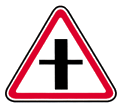 1.7.1 · Intersection with Secondary Road (Both Sides)
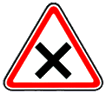 1.6 · Intersection of Roads of Equal Importance
Law: Art. 5 ¶37 Annex 1, sign 1.7.1 Annex 1, sign 1.6
3 Giving way, with or without stopping
Signs 2.3 and 2.4 apply to the crossing of carriageways in front of which they stand.
2.3 · Yield (Give Way)
2.4 · No Entry Without Stopping
Law: Annex 1, group 2, note 1
Give way to traffic on the road you cross. The Yield (Give Way) sign 2.3 means the driver must give way to traffic on the road being crossed. If plate 8.13, showing the direction of the main road, is placed with the sign, the driver must give way to traffic on the main road instead.
2.3 · Yield (Give Way)
Law: Annex 1, sign 2.3 Annex 1, sign 8.13
Stop first, then give way. At the No Entry Without Stopping sign 2.4, the driver must not go on without stopping first. The stop is made at the stop line or, if there is none, at the edge of the carriageway being crossed. The driver must also give way to drivers on the road being crossed. If plate 8.13, showing the direction of the main road, is placed with the sign, the driver must give way to traffic on the main road after stopping.
2.4 · No Entry Without Stopping
Law: Annex 1, sign 2.4 Annex 1, sign 8.13
Stopping before a railway crossing or post. Sign 2.4 is placed where vehicles on the crossing road cannot be seen well enough. Sometimes it is also placed before a railway crossing or a quarantine post. Before a railway crossing or quarantine post, the driver must stop at the stop line or, if there is none, before the sign.
2.4 · No Entry Without Stopping
Law: Annex 1, sign 2.4
4 Narrow sections of road and oncoming traffic
Signs 2.5 and 2.6 are placed directly before the narrow section of road. Sign 2.5 is sometimes placed in advance as well, with the Distance to Object plate 8.1.1. The Road Narrows (Both Sides) warning sign 1.21.1 stands in advance, before the narrow section begins.
2.5 · Priority of Oncoming Traffic
2.6 · Priority over Oncoming Traffic
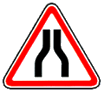 1.21.1 · Road Narrows (Both Sides)
Law: Annex 1, group 2, note 1 Annex 1, sign 8.1.1 Annex 1, sign 1.21.1 Annex 1, group 1, note 1
Oncoming traffic goes first. Where the Priority of Oncoming Traffic sign 2.5 stands, the driver must not enter the narrow section of road if this would hinder traffic coming the other way. The driver must give way to oncoming vehicles on the narrow section or at its far approach.
2.5 · Priority of Oncoming Traffic
Law: Annex 1, sign 2.5
The Priority over Oncoming Traffic sign 2.6 gives the driver priority over oncoming vehicles on a narrow section of road. It applies on the narrow section, not at intersections.
2.6 · Priority over Oncoming Traffic
Law: Annex 1, sign 2.6
The two are easy to mix up, since both show two arrows pointing opposite ways. The red arrow shows the direction of the drivers who give way. On the round sign 2.5 the red arrow is yours, so you let the oncoming driver through. On the blue square sign 2.6 the red arrow is the oncoming one, so the oncoming driver lets you through.
2.5 · Priority of Oncoming Traffic
2.6 · Priority over Oncoming Traffic
Law: Annex 1, sign 2.5 Annex 1, sign 2.6
Sign 2.5 also asks you to give way, but only to oncoming vehicles on the narrow section or at its far approach. Sign 2.3 is about a crossing: you give way to drivers on the road you are crossing.
2.3 · Yield (Give Way)
2.5 · Priority of Oncoming Traffic
Law: Annex 1, sign 2.3 Annex 1, sign 2.5
You are approaching a narrow bridge with sign 2.5 before it, and an oncoming car is approaching the bridge too. Just before the bridge a side road joins from the right, where a truck waits at sign 2.3. The oncoming car goes first, because at sign 2.5 you give way to it. Then you go, and the truck goes last: its driver gives way to both cars on the road being crossed.
Key points
- The Main Road sign gives priority at unregulated intersections within its zone, up to the End of Main Road sign.
- At the intersection that the Intersection with Secondary Road (Both Sides) sign warns of, the main road is the one on which that sign stands.
- At the Yield (Give Way) sign the driver gives way to traffic on the road being crossed. At the No Entry Without Stopping sign the driver stops at the stop line or, if there is none, at the edge of the carriageway being crossed, then gives way.
- At a narrow section of road, the Priority of Oncoming Traffic sign means the driver lets oncoming traffic through. The Priority over Oncoming Traffic sign gives the driver priority there. The red arrow shows the direction of the drivers who give way.
- Both narrow-section signs stand directly before the narrow section of road, and the Road Narrows (Both Sides) warning sign stands in advance.
Plain-language summary for exam preparation; the law's text prevails.
Now answer this lesson's questions
15 exam questions are about this lesson. A wrong answer comes back until you get it right, and you see which questions are ready for the exam.
Practise the questionsFree account · sign in with e-mail or Google
15 exam questions
Practise the questions