
Lesson 7 of 29 · Signs and markings
Warning signs
9 min 35 questions
This lesson shows how to recognise warning signs by their shape, how far before a dangerous section they stand and which of them are repeated. Then come the signs before a railway crossing, and pairs of signs that are easy to mix up.
Road signs are set out in the first annex to the Law of Georgia on Road Traffic. Warning signs are its first group, so their numbers start with 1.
Law: Art. 5 ¶64 Annex 1 Annex 1, group 1
1 A triangle before the danger
35 35 exam questions on this sectionWarning signs tell road users that they are approaching a dangerous section of road and what kind of danger it holds. Driving through such a section calls for appropriate measures. That is why the sign usually stands in advance, before the dangerous section begins, so that you have time to take them.
Law: Annex 1, group 1 Annex 1, group 1, note 1
Most warning signs are white triangles, point up, with a red border and a black symbol, for example 1.16. The group also has signs of other shapes. Before a railway crossing without a barrier there are red and white crosses, for example 1.3.2. Outside populated areas there are also oblong signs with slanted red stripes before a railway crossing, for example 1.4.1. On small-radius bends with restricted visibility, at T-shaped intersections and forks, and around road works there are red oblongs with white chevrons, for example 1.35.1.
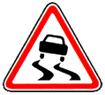 1.16 · Slippery Road
 1.3.2 · Multi-Track Railway
 1.4.1 · Approaching Railway Crossing
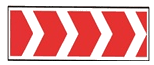 1.35.1 · Chevron — Direction of the Bend
Law: Annex 1, group 1
The usual distance: 150–300 or 50–100 metres. Outside a populated area, signs 1.1, 1.2 and 1.5–1.34 are placed 150–300 metres before the start of the dangerous section of road. In a populated area they are placed 50–100 metres before it. Where necessary, signs are placed at another distance, and then plate 8.1.1 (Distance to Object) shows it. The English exam questions often call a populated area an inhabited area, and the area outside it an uninhabited area.
 8.1.1 · Distance to Object
Law: Annex 1, group 1, note 1
Plate 8.1.1 shows the distance from the sign to the start of the dangerous section. Without a plate, signs 1.1, 1.2 and 1.5–1.34 stand at the distance given above. Without a plate, the annex also sets other places, for example: a repeated sign at least 50 metres before, sign 1.26 for short works on the carriageway 10–15 metres from the site. Signs 1.3.1 and 1.3.2 stand directly before the railway crossing.
Law: Annex 1, group 1, note 1 Annex 1, sign 8.1.1
Repetition of a sign means placing the main sign again on the same side of the road, at a certain distance. Duplication of a sign means placing the same sign a second time on that section of road, opposite the first one across the road.
Law: Art. 5 ¶55 ¶54
Seven signs are repeated. Outside a populated area, signs 1.1, 1.2, 1.10, 1.11, 1.23, 1.24 and 1.26 are repeated, and signs 1.24 and 1.26 in a populated area too. The second sign is placed at least 50 metres before the start of the dangerous section. The first one stands at the usual distance: 150–300 metres outside a populated area, 50–100 metres inside one. The English exam questions often say a repeated sign is “reposted”.
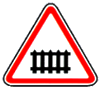 1.1 · Railway Crossing with Barrier
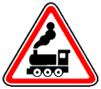 1.2 · Railway Crossing without Barrier
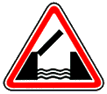 1.10 · Drawbridge
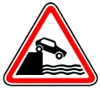 1.11 · Exit to Embankment
 1.23 · Pedestrian Crossing
 1.24 · Children
 1.26 · Road Works
Law: Annex 1, group 1, note 1
2 Before a railway crossing
Sign 1.1 (Railway Crossing with Barrier) warns of an approaching railway crossing with a barrier. Sign 1.2 (Railway Crossing without Barrier) warns of an approaching crossing without one. The first shows a fence, the second a steam locomotive: the locomotive means there is no barrier. Sign 1.5 (Tram Line Crossing), with a tram on it, warns that the road crosses a tram line. The English exam questions often call a railway crossing a railroad crossing.
1.1 · Railway Crossing with Barrier
1.2 · Railway Crossing without Barrier
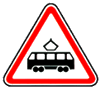 1.5 · Tram Line Crossing
Law: Annex 1, sign 1.1 Annex 1, sign 1.2 Annex 1, sign 1.5
Sign 1.3.1 (Single-Track Railway) warns of an approaching crossing of a single-track railway without a barrier. Sign 1.3.2 (Multi-Track Railway) warns of an approaching crossing of two or more tracks without a barrier. Both stand on the road directly in front of the railway crossing.
 1.3.1 · Single-Track Railway
1.3.2 · Multi-Track Railway
Law: Annex 1, sign 1.3.1 Annex 1, sign 1.3.2 Annex 1, group 1, note 1
1.4.1 · Approaching Railway Crossing
 1.4.2 · Approaching Railway Crossing
 1.4.3 · Approaching Railway Crossing
 1.4.4 · Approaching a Railway Crossing
 1.4.5 · Approaching a Railway Crossing
 1.4.6 · Approaching a Railway Crossing
Striped signs on the right and on the left. Signs 1.4.1–1.4.6 (Approaching Railway Crossing) give the driver an extra warning of a railway crossing outside a populated area. Signs 1.4.1–1.4.3 stand on the right side of the road and 1.4.4–1.4.6 on the left. In the direction of travel, signs 1.4.1 and 1.4.4 go with the main and repeated sign 1.1 or 1.2, and 1.4.3 and 1.4.6 with the duplicate one. Signs 1.4.2 and 1.4.5 stand on their own, at an equal distance between the main and repeated signs 1.1 or 1.2.
Law: Annex 1, sign 1.4.1 Annex 1, group 1, note 1
You are driving outside a populated area towards a railway crossing without a barrier. At 150–300 metres before it, the main sign 1.2 stands on the right side of the road together with sign 1.4.1, the one with three stripes. Midway between the main and repeated signs, sign 1.4.2 stands on its own. The repeated sign 1.2 stands at least 50 metres before the crossing.
3 Intersections, bends and slopes
Sign 1.6 (Intersection of Roads of Equal Importance) marks an intersection of roads of equal importance. Sign 1.7.1 (Intersection with Secondary Road) marks a crossing with a road whose drivers have the duty of giving way. Sign 1.6 shows a diagonal cross; on 1.7.1 the main road is a wide line and the secondary road a narrow one.
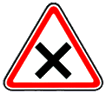 1.6 · Intersection of Roads of Equal Importance
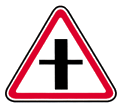 1.7.1 · Intersection with Secondary Road (Both Sides)
Law: Annex 1, sign 1.6 Annex 1, sign 1.7.1
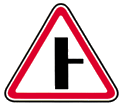 1.7.2 · Side Road Junction (Right)
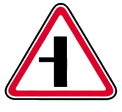 1.7.3 · Side Road Junction (Left)
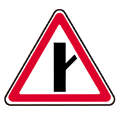 1.7.4 · Side Road Junction
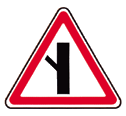 1.7.5 · Side Road Junction
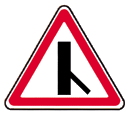 1.7.6 · Side Road Junction
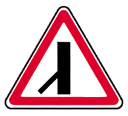 1.7.7 · Side Road Junction
Signs 1.7.2–1.7.7 (Side Road Junction) mark a junction with a road whose drivers have the duty of giving way. Signs 1.7.1–1.7.7 are placed 150–300 metres before the start of the dangerous section outside a populated area, and 50–100 metres before it inside one. More on who gives way to whom at an intersection in the lesson on intersections.
Law: Annex 1, sign 1.7.1 Annex 1, sign 1.7.2
Signs 1.12.1 and 1.12.2 (Dangerous Curve) mark a dangerous bend of small radius or with restricted visibility: 1.12.1 to the right, 1.12.2 to the left. Signs 1.13.1 and 1.13.2 (Dangerous Curves) mark a section of road with dangerous bends: on 1.13.1 the first bend is to the right, on 1.13.2 to the left. Signs 1.12.1 and 1.12.2 show one bend, 1.13.1 and 1.13.2 several.
 1.12.1 · Dangerous Curve
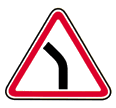 1.12.2 · Dangerous Bend to the Left
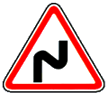 1.13.1 · Dangerous Curves
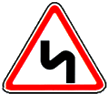 1.13.2 · Dangerous Curves
Law: Annex 1, sign 1.12.1 Annex 1, sign 1.13.1
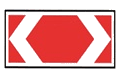
Signs 1.35.1–1.35.6 (Chevron — Direction of the Bend), for example 1.35.1 and 1.35.4, show the direction of travel on a small-radius bend with restricted visibility. Signs 1.35.1–1.35.3 point to the right, 1.35.4–1.35.6 to the left. Signs 1.36.1 and 1.36.2 (Chevron — Direction at a T-Junction) show the direction of travel at a T-shaped intersection or a fork, to the right or to the left. Both groups also show the direction of the detour around road works.
1.35.1 · Chevron — Direction of the Bend
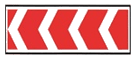 1.35.4 · Chevron — Direction of the Bend
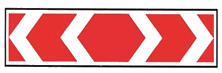 1.36.1 · Chevron — Direction at a T-Junction
 1.36.2 · Chevron — Direction at a T-Junction
Law: Annex 1, sign 1.35.1 Annex 1, sign 1.36.1
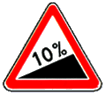
An ascent and a descent in a row. Sign 1.14 (Steep Descent) warns of an approaching section of road with a steep descent, and sign 1.15 (Steep Ascent) of one with a steep ascent. If an ascent and a descent (or a descent and an ascent) follow each other, these signs may stand without plate 8.1.1. Signs 1.14 and 1.15 may then be placed directly before the ascent and the descent.
 1.14 · Steep Descent
 1.15 · Steep Ascent
Law: Annex 1, sign 1.14 Annex 1, sign 1.15 Annex 1, group 1, note 1
4 Road surface and width
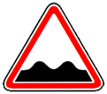
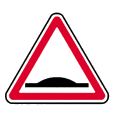
Sign 1.17 (Uneven Road) marks a section of road whose carriageway is damaged: wavy, with potholes, with rough joints at bridges and so on. Sign 1.18 (Road Hump) marks a section with an artificial bump built for a forced reduction of speed. Sign 1.17 shows two bumps, sign 1.18 a single one. Sign 1.20 (Dangerous Verge) marks a section of road whose verge does not meet the current standards. The English exam questions often call the carriageway the driveway.
 1.17 · Uneven Road
 1.18 · Road Hump
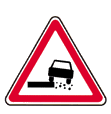 1.20 · Dangerous Verge
Law: Annex 1, sign 1.17 Annex 1, sign 1.18 Annex 1, sign 1.20
Sign 1.16 (Slippery Road) marks a slippery section of carriageway where the coefficient of grip between tyre and road surface is below 0.4. Sign 1.19 (Loose Gravel) marks a section where gravel, crushed stone and the like can be thrown up from vehicle wheels.
1.16 · Slippery Road
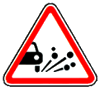 1.19 · Loose Gravel
Law: Annex 1, sign 1.16 Annex 1, sign 1.19
Signs 1.21.1–1.21.3 (Road Narrows) mark a section of road where the carriageway gets narrower: 1.21.1 on both sides, 1.21.2 on the right, 1.21.3 on the left.
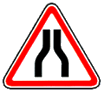 1.21.1 · Road Narrows (Both Sides)
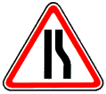 1.21.2 · Road Narrows (Right Side)
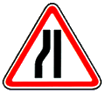 1.21.3 · Road Narrows (Left Side)
Law: Annex 1, sign 1.21.1
Sign 1.22 (Two-Way Traffic) marks the start of a section of road with two-way traffic after a section with one-way traffic. Arrows in both directions also appear on the round sign 2.5 (Priority of Oncoming Traffic) and the blue square 5.9 (End of Reversible Traffic), but these are not warning signs.
 1.22 · Two-Way Traffic
 2.5 · Priority of Oncoming Traffic
 5.9 · End of Reversible Traffic
Law: Annex 1, sign 1.22 Annex 1, sign 2.5 Annex 1, sign 5.9
Sign 1.33 (Traffic Queue) marks a section of road that is temporarily blocked. It shows cars standing one behind the other.
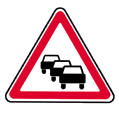 1.33 · Traffic Queue
Law: Annex 1, sign 1.33
5 People, works and nature by the road
Sign 1.23 (Pedestrian Crossing) warns of an approaching pedestrian crossing marked by signs 5.19.1 and 5.19.2 and/or markings 1.14.1–1.14.3. Sign 1.24 (Children) warns of a children’s institution near the section of road, from which children are likely to appear on the carriageway. Sign 1.23 shows a pedestrian on a crossing, 1.24 running children.
1.23 · Pedestrian Crossing
1.24 · Children
Law: Annex 1, sign 1.23 Annex 1, sign 1.24
Sign 1.25 (Bicycle Path Crossing) warns of an approaching place where a bicycle path marked by sign 4.4 crosses the carriageway. Sign 4.4 (Bicycle Path) is round and blue, and marks the bicycle path itself. The round sign with a red border, 3.9 (No Cycles), is a prohibitory sign: it bans bicycles and mopeds.
 1.25 · Bicycle Path Crossing
 4.4 · Bicycle Path
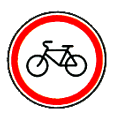 3.9 · No Cycles
Law: Annex 1, sign 1.25 Annex 1, sign 4.4 Annex 1, sign 3.9
Sign 1.26 (Road Works) marks a section of road where road works are under way. For short works on the carriageway, sign 1.26 is placed 10–15 metres from the work site. Plate 8.1.1 is not used then.
1.26 · Road Works
Law: Annex 1, sign 1.26 Annex 1, group 1, note 1
Sign 1.10 (Drawbridge) warns of an approaching drawbridge or ferry crossing. Sign 1.11 (Exit to Embankment) marks an exit onto an embankment or the bank of a reservoir.
1.10 · Drawbridge
1.11 · Exit to Embankment
Law: Annex 1, sign 1.10 Annex 1, sign 1.11
Sign 1.29 (Falling Rocks) marks a section of road whose carriageway is not protected from avalanches, landslides or falling rocks. Sign 1.30 (Side Wind) marks a section where strong crosswinds are possible. Sign 1.31 (Low-Flying Aircraft) marks a section near an airfield where aeroplanes or helicopters fly at low height.
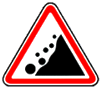 1.29 · Falling Rocks
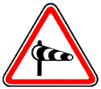 1.30 · Side Wind
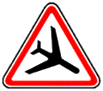 1.31 · Low-Flying Aircraft
Law: Annex 1, sign 1.29 Annex 1, sign 1.30 Annex 1, sign 1.31
Sign 1.34 (Other Dangers) marks a section of road where a danger is possible that no other warning sign covers.
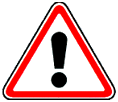 1.34 · Other Dangers
Law: Annex 1, sign 1.34
Key points
- Warning signs tell road users that a dangerous section is ahead and what kind of danger it holds. Most of them are white triangles with a red border.
- Outside a populated area signs 1.1, 1.2 and 1.5–1.34 stand 150–300 metres before the dangerous section, inside one 50–100 metres before it. Where necessary they stand at another distance, shown on plate 8.1.1.
- Outside a populated area, both railway crossing signs (with and without a barrier) are repeated. So are the signs for a drawbridge, an exit to an embankment, a pedestrian crossing, children and road works. Signs 1.24 and 1.26 are repeated inside one too. The second sign stands at least 50 metres before the start of the dangerous section.
- A fence on the sign means a crossing with a barrier, a locomotive one without. Signs 1.4.1–1.4.3 stand on the right side of the road, 1.4.4–1.4.6 on the left.
- Sign 1.6 marks an intersection of roads of equal importance, sign 1.7.1 a crossing with a secondary road. Signs 1.12.1 and 1.12.2 mark one dangerous bend, 1.13.1 and 1.13.2 several. Sign 1.17, with two bumps, marks a damaged carriageway; sign 1.18, with one, a road hump.
Plain-language summary for exam preparation; the law's text prevails.
Now answer this lesson's questions
35 exam questions are about this lesson. A wrong answer comes back until you get it right, and you see which questions are ready for the exam.
Practise the questionsFree account · sign in with e-mail or Google
The law behind this lesson
35 exam questions
Practise the questions