
Lesson 21 of 29 · Special places, people, vehicle, documents
Motorways, tunnels, residential zones, route vehicles
11 min 43 questions
Some places have rules of their own: motorways, tunnels, residential and pedestrian zones. This lesson covers who may use a motorway and in which lanes. Then comes how a driver joins and leaves it, and what to do if the vehicle breaks down there. Last come route vehicles, trams, tunnels and residential zones, where pedestrians have priority.
1 Who the motorway is for
18 18 exam questions on this sectionA motorway is a road specially built for motor vehicles that does not serve adjacent territory. Apart from a few places, it has separate carriageways for the two directions, kept apart by a dividing strip. It is marked by sign 5.1 (Motorway).
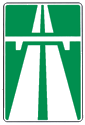 5.1 · Motorway
Motor vehicles and their trailers only. On a motorway and at its entrances and exits, pedestrians, animals, bicycles, mopeds and two-wheeled electric self-balancing vehicles are prohibited. So are all vehicles other than motor vehicles and their trailers. A motor vehicle whose design speed does not exceed 40 km/h is prohibited too, unless it moves there under an agreement with the authorized body. Learner driving is prohibited too, both on the motorway itself and at its entrances and exits.
Law: Art. 38 ¶1 ¶1(a) ¶1(b)
In the law, a motor vehicle is a mechanical vehicle normally used to carry people or goods on the road, or to tow vehicles that do. A tractor is not one: for a tractor, carrying and towing are only an auxiliary function. So a tractor may not use a motorway, while a quadricycle and a motorcycle may. A moped may not: the law names it in the ban.
Law: Art. 5 ¶5 Art. 38 ¶1(a)
An expressway counts as a motorway. A road meant for motor vehicles, marked by sign 5.3 (Expressway), that does not serve adjacent territory counts as a motorway. The motorway rules apply there: on who uses it, on lanes, stopping, U-turns, joining and leaving. The motorway speed limit does not apply to it. More on this in the lesson on speed.
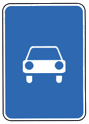 5.3 · Expressway
Law: Art. 38 ¶5 Annex 1, sign 5.3 Art. 33 ¶7(b.a)
A passenger car, a bicycle and a truck with a maximum permissible mass over 3.5 t are on a road marked by sign 5.3 that does not serve adjacent territory. The bicycle may not be there at all, just as on a motorway. If sign 3.22 stands below, it bans overtaking for that truck, not for the passenger car.
2 Lanes, joining and leaving
No further than the second lane. On a motorway and at its entrances and exits, a driver must not drive two kinds of motor vehicle beyond the second lane. One is a motor vehicle carrying goods whose maximum permissible mass exceeds 3.5 t. The other is a motor vehicle with a trailer, if their total length exceeds 7 m.
Law: Art. 38 ¶1(c) ¶1(c.c)
Lanes are counted from the right edge of the carriageway, so these vehicles keep to the first and second. A road train does use the motorway. A category CE vehicle is a road train built on a category C truck, whose maximum permissible mass exceeds 3.5 t, so it goes no further than the second lane. The ban is for motor vehicles carrying goods. It does not cover a motor vehicle intended for carrying passengers, such as a bus, even if its maximum permissible mass exceeds 3.5 t.
Law: Art. 38 ¶1(c.c) Art. 5 ¶3
No U-turns, no reversing. On a motorway and at its entrances and exits, a driver must not make a U-turn or reverse. Driving onto the central dividing strip or onto the cross-connections of both carriageways of the road is prohibited too. So if you have missed an exit or a cross-connection, you may not reverse back to it, nor cross the central dividing strip.
Law: Art. 38 ¶1(c) ¶1(c.b)
Joining: give way to traffic already on it. When joining a motorway, a driver must give way to motor vehicles already moving on the motorway. If there is an acceleration lane, the driver must use it. Moving from it into the next lane, the driver must give way to vehicles travelling in that lane, a motorcycle included.
Law: Art. 38 ¶2 Art. 32 ¶14
Leaving: move to the exit lane in good time. When leaving a motorway, a driver must move in good time to the lane next to the exit. The driver must then enter the deceleration lane as soon as possible, if there is one. Cutting across several lanes to the exit at the last moment is prohibited.
Law: Art. 38 ¶3
3 Stopping and breakdowns on a motorway
Stop only where parking is marked. On a motorway and at its entrances and exits, stopping or parking the motor vehicle or its trailer is prohibited except in specially marked places set aside for parking. In a forced stop caused by circumstances beyond the driver’s control, the driver must do everything to get it off the carriageway. If that cannot be done at once, the driver must switch on the hazard warning lights, if fitted. The driver must also mark it with the emergency stopping sign far enough back to warn approaching drivers in time.
Law: Art. 38 ¶1(c) ¶1(c.a)
Not onto the central dividing strip. Driving onto the central dividing strip or the cross-connections between carriageways is prohibited even in a forced stop. The wide solid line 1.2.1 at a motorway carriageway’s edge may be crossed only where it is on the driver’s right, for stopping on the road’s shoulder. So the motor vehicle is moved to the right, for example onto the shoulder, not left towards the central dividing strip. On a motorway, the hazard warning lights and the emergency stopping sign are used even when the car has stopped on the shoulder.
Law: Art. 38 ¶1(c.b) ¶1(c.a) Annex 2, marking 1.2.1 Art. 52 ¶1(b) ¶2(b)
Towing with a makeshift device. A vehicle towed with a makeshift device must not enter a motorway. A makeshift device means a rope, a wire or something similar. A defective vehicle that broke down on the motorway and is towed with such a device must leave the motorway at the nearest exit. It may not carry on along the motorway past that exit.
Law: Art. 38 ¶4
4 Route vehicles and trams
10 10 exam questions on this sectionA route vehicle is a vehicle intended for carrying passengers on the road and moving on an established route, for example a bus on its route. It may have a lane intended for the movement of route vehicles, where route vehicles move with or against the general flow of traffic. Road markings separate that lane from the rest of the carriageway.
Law: Art. 5 ¶67 ¶67¹
A bus pulling away from its stop. In a populated area, drivers of other vehicles must slow down and stop if necessary, so that a route vehicle can pull away from its stop. This also applies to a driver who is just moving off: that driver lets the route vehicle go first. A driver must not brake sharply, except when braking is needed to prevent a road traffic accident. The route vehicle’s driver, after signalling with the turn indicator, must take precautions and start moving only after making sure that other vehicles are giving way.
Law: Art. 41 ¶1 Art. 33 ¶4
This rule applies only in a populated area. Outside one, you have no duty to give way to a bus leaving its stop. Pulling away from a stop is a maneuver, so the bus driver starts it only once sure that it will not endanger other road users. The English exam questions often call the area outside a populated area an uninhabited area.
No driving or stopping in the lane for route vehicles. A lane intended for the movement of route vehicles is marked by signs 5.11, 5.13.1, 5.13.2, 5.14 or 5.41. Other vehicles must not drive or stop in that lane. The law makes exceptions only for a few cases, for example taxis admitted by the municipality. The ban covers the motor vehicle of a person with disabilities too.
 5.11 · Road with Lane for Route Service Vehicles (Counter-Flow)
 5.14 · Lane for Route Service Vehicles
Law: Art. 41 ¶3 ¶4 Annex 1, sign 5.11 Annex 1, sign 5.14
Broken line: move into it before turning. If the lane is separated from the rest of the carriageway by a broken marking line, other vehicles must move into it when turning. At such places they may also enter it when joining the road, and to let passengers get in or out at the right edge of the carriageway. That is allowed if it does not obstruct route vehicles or the taxis, motorcycles and mopeds admitted to the lane. Where a solid line separates the lane, entering it to pick up passengers is prohibited.
Law: Art. 41 ¶3
You are in the second lane and about to turn right, and to your right is a lane for route vehicles separated by a broken line. You move into that lane in good time, without obstructing route vehicles in it, and turn from there, not from the second one.
Sign 5.13.1 or 5.13.2 stands before a turn onto a road marked by sign 5.11. Its arrows show which way the general flow goes and which way the route vehicles go. You may not turn the way only route vehicles go: that would mean driving in their lane.
 5.13.1 · Exit onto Road with Counter-Flow Route Service Lane
 5.13.2 · Exit onto Road with Counter-Flow Route Service Lane
Law: Annex 1, sign 5.13.1 Annex 1, sign 5.13.2 Annex 1, sign 5.11 Art. 41 ¶3
Outside intersections the tram goes first. Outside intersections, where tram tracks cross the carriageway, a tram has priority over trackless vehicles, except when it is leaving the depot. This holds even if the car had priority at the intersection and crosses the tracks just beyond it. Intersections have rules of their own. More on this in the lesson on intersections.
Law: Art. 41 ¶2
5 A tunnel marked by a sign
4 4 exam questions on this sectionA tunnel counts as marked by a road sign when sign 1.32 stands before it or sign 5.37 (Tunnel) stands at its start. The rules below apply in both cases.
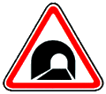 1.32 · Tunnel
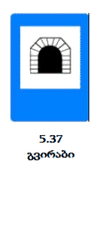 5.37 · Tunnel
Law: Art. 42 Annex 1, sign 1.32 Annex 1, sign 5.37
No U-turns or reversing; headlights on. In a tunnel marked by a road sign, a driver must not reverse or make a U-turn. The driver must switch on the high or dipped beam headlights, whether or not the tunnel is lit.
Stop only in an emergency or in danger. In a tunnel marked by a road sign, a driver may stop or park the vehicle only in an emergency or in danger. The driver must use a specially marked place if possible; if the tunnel has none, stopping or parking in danger is still allowed. During a long stop, the driver must switch off the engine.
Law: Art. 42(c) (d)
6 Residential and pedestrian zones
11 11 exam questions on this sectionA residential zone is a built-up area where special road traffic rules apply and whose entrances and exits are marked by the appropriate road signs. Sign 5.21 marks where it begins, and sign 5.22 where it ends. The same rules apply in yards and in places declared pedestrian zones. A residential zone and a populated area are not the same thing. The English exam questions often call a residential zone a “built-up area”, and sometimes even an “inhabited area”.
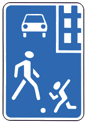 5.21 · Residential Zone
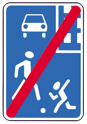 5.22 · End of Residential Zone
Law: Art. 5 ¶75 Art. 44 ¶2 ¶4 Annex 1, sign 5.21 Annex 1, sign 5.22
Pedestrians have priority, within reason. In a residential zone, pedestrians may walk across the whole width of the road, and children are allowed to play. Here and in a pedestrian zone, pedestrians have priority over other road users. But a pedestrian must not hold up traffic without good reason.
Law: Art. 44 ¶1 ¶1(a) ¶1(d) ¶3
No faster than 20 km/h, and mind the pedestrians. In a residential zone, the driver must drive at no more than 20 km/h. The driver must not endanger pedestrians or restrict their movement, and must stop the vehicle if necessary. Parking a mechanical vehicle is prohibited there outside places specially set aside and marked by a sign or markings.
Law: Art. 44 ¶1 ¶1(b) ¶1(c) ¶1(f)
What is banned in the zone. In pedestrian zones and residential zones, through traffic, learner driving and parking with the engine running are prohibited. A motor vehicle’s design speed makes no difference here: what counts is the speed it is actually driven at.
Law: Art. 44 ¶3 ¶1(b)
Leaving the zone: give way to everyone. When leaving a residential zone, a road user must give way to other road users where the roads cross. That means giving way to everyone: vehicles, bicycle and moped drivers, and pedestrians.
Law: Art. 44 ¶1(e) Annex 1, sign 5.22
You are leaving a residential zone past sign 5.22 into an intersection. A car is coming along the road from the left, a moped from the right, and a pedestrian is crossing. You go last, giving way to all three, the car on your left included.
Key points
- Pedestrians, bicycles, mopeds and tractors are prohibited on a motorway and at its entrances and exits. So are motor vehicles with a design speed of 40 km/h or less, unless allowed by agreement with the authorized body, and learner driving.
- On a motorway, a goods vehicle with a maximum permissible mass over 3.5 t and a motor vehicle with a trailer over 7 m long in total stay within the first two lanes. The 3.5 t limit does not cover a bus.
- On a motorway, U-turns and reversing are prohibited. Driving onto the central dividing strip or the cross-connections of the carriageways is prohibited even in a forced stop. A defective vehicle towed on a rope leaves the motorway at the nearest exit.
- In a populated area, others give way to a bus leaving its stop; outside one, the bus waits. Other vehicles do not drive or stop in the lane for route vehicles; the law makes exceptions only for a few cases, for example taxis admitted by the municipality. Where a broken line separates it, they enter it only to turn, to join the road or to let passengers in or out at the right edge. That is allowed if it does not obstruct route vehicles or the taxis, motorcycles and mopeds admitted to the lane.
- In a tunnel marked by a sign, U-turns and reversing are prohibited, and the headlights must be on. Stopping is allowed only in an emergency or in danger, even where there are no marked places.
- In a residential zone, pedestrians have priority, speed is 20 km/h at most, and through traffic and learner driving are prohibited. Leaving it, you give way to all other road users.
Plain-language summary for exam preparation; the law's text prevails.
Now answer this lesson's questions
43 exam questions are about this lesson. A wrong answer comes back until you get it right, and you see which questions are ready for the exam.
Practise the questionsFree account · sign in with e-mail or Google
The law behind this lesson
43 exam questions
Practise the questions