
Lesson 22 of 29 · Special places, people, vehicle, documents
Pedestrians, cyclists, mopeds
10 min 29 questions
A pedestrian or a cyclist has no protection if a car hits them, so the law asks drivers for special caution towards them. You will learn where pedestrians walk and cross the road, and how to behave at a pedestrian crossing. A separate section covers the places where a pedestrian is easy to miss: a route vehicle’s stopping place, a stopped vehicle, a crossing in front of a bus. The rules for bicycles, mopeds and motorcycles close the lesson.
1 Special caution
3 3 exam questions on this sectionSpecial care with pedestrians and cyclists. When driving on the roads, a driver must not do anything that endangers pedestrians. A driver must take special care with pedestrians, especially children, elderly people and persons with disabilities, and with cyclists.
Law: Art. 25 ¶1 Art. 21 ¶6
An elderly pedestrian often walks more slowly than others. They may also turn back halfway across the road, or lose their balance and fall. A driver near them allows for all of this at once.
Always give way to a blind pedestrian. A driver must in all cases give way to a blind pedestrian walking with a white cane or with a guide dog.
Law: Art. 21 ¶6
In places for pedestrians: at low speed. A driver who, in the cases the law provides for, enters places meant for pedestrians must take the utmost care. The driver must drive at low speed so as to stop if necessary.
Law: Art. 25 ¶5
2 Where pedestrians walk and cross
4 4 exam questions on this sectionOutside populated areas: facing the traffic. Outside populated areas, on a two-way road with no dividing strip and no sidewalk, a pedestrian must walk on the shoulder facing the traffic. If there is no shoulder or it cannot be used, they must walk on the left side of the carriageway, also facing the traffic. The exception is when, in the situation at hand, walking on the right side of the carriageway with the traffic is safer.
Law: Art. 24 ¶5
Walking a bicycle or in a wheelchair: on the right. On such a road, a person walking a bicycle, moped or motorcycle and a person with disabilities in a wheelchair must keep to the right side of the carriageway. The law treats them as pedestrians, but their side is the right, not the left. The English exam questions often call this carrying a bicycle or moped by hand.
Law: Art. 24 ¶5 Art. 5 ¶87
Cross at a crossing or an intersection. A pedestrian must cross the carriageway at a pedestrian crossing, elevated and underground ones included, or, failing that, at an intersection along the line of the sidewalks or shoulders. If neither a crossing nor an intersection is in sight, a pedestrian may cross the road at a right angle to the axis of the carriageway. This is allowed only where there is no dividing strip or barrier and the road is clearly visible both ways. A dividing strip rules such a crossing out, even where the road is clearly visible both ways.
Law: Art. 24 ¶8
When there is no time to finish crossing. Once on the carriageway, a pedestrian must not delay crossing or stop there, unless it is for traffic safety. A pedestrian who has not managed to cross the road must stop on a safety island, or on the strip or line dividing flows of vehicles going in opposite directions. They must carry on only once sure it is safe, taking the signals of the traffic light or traffic controller into account.
Law: Art. 24 ¶10
3 The driver at a pedestrian crossing
15 15 exam questions on this sectionA pedestrian crossing is a section of the carriageway meant for pedestrians to cross the road. It is marked by signs 5.19.1 and 5.19.2 and/or by road markings 1.14.1–1.14.2. Without markings, its width is the distance between those two signs. A crossing is regulated when a traffic light or a traffic controller regulates vehicle traffic there, and unregulated otherwise. The English exam questions often call a pedestrian crossing a crosswalk.
Law: Art. 5 ¶86 Art. 25 ¶2(a) ¶2(b)
Regulated crossing: stop before it. If vehicle traffic is regulated by a traffic light or a traffic controller, the driver must stop at a signal prohibiting movement. The driver stops before the pedestrian crossing or at the transverse marking before it. Once free to go on, the driver must not obstruct or endanger pedestrians who have stepped onto the crossing. On a road with a pedestrian crossing, it is the crossing that sets the stopping place, wherever the controller stands.
Law: Art. 25 ¶2(a)
Turning towards a crossing: at low speed. Where traffic is regulated this way, a driver turning onto another road with a pedestrian crossing at its entrance must turn only at low speed. If necessary, the driver must stop and let through the pedestrians who have stepped or are stepping onto the crossing.
Law: Art. 25 ¶2(a)
You turn right on a green traffic light, and pedestrians have already stepped onto the pedestrian crossing of the road you are turning into. The green light allows the turn but does not change this rule: you turn at low speed, stop and let them cross.
Unregulated crossing: slow down. If vehicle traffic is regulated by neither a traffic light nor a traffic controller, a driver approaching a pedestrian crossing must reduce speed accordingly. This is so as not to endanger pedestrians who have stepped or are stepping onto the crossing. If necessary, the driver must stop and let the pedestrians cross.
Law: Art. 25 ¶2(b)
First, room beyond the crossing. A driver must not enter a pedestrian crossing without first making sure they will not have to stop on it.
Law: Art. 25 ¶6
Beyond the crossing, cars are stuck in a queue and there is no room for yours. If you drove on, you would stop right on the crossing and block it for pedestrians. So you wait before the crossing until there is room beyond it.
Turning where there is no crossing. Sometimes the carriageway has no pedestrian crossing marked by road markings, a sign or a traffic light. Then a driver turning onto another road must give way to pedestrians who have stepped onto its carriageway. The driver must take special care with pedestrians crossing to board a route vehicle or after getting off one.
Law: Art. 25 ¶3
Adjacent territory: give way to pedestrians. When joining a road from adjacent territory, or turning off the road into such territory, a driver must give way to pedestrians. Adjacent territory is, for example, a yard, a car park or a filling station. More on this in the lesson on turns and U-turns.
Law: Art. 25 ¶7 Art. 5 ¶38
5 Bicycles, mopeds, motorcycles
7 7 exam questions on this sectionIn the law, a moped and a motorcycle are different vehicles. A moped is a two- or three-wheeled mechanical vehicle with a design speed above 25 km/h but not above 45 km/h. Unless it is electric, a two-wheeled moped’s engine has a working volume of no more than 50 cm³. A motorcycle is a two-wheeled mechanical vehicle, with or without a sidecar, whose engine is over 50 cm³ and/or whose design speed is over 45 km/h.
Law: Art. 5 ¶42 ¶44
Bicycle at 14 years, moped at 16 years. A person may ride a bicycle or a two-wheeled electric self-balancing vehicle on the road from 14 years of age, and a moped from 16 years. This is allowed only with the appropriate special helmet. 14 years is the age for a bicycle, not for a moped.
Law: Art. 43 ¶1
All wheels on the road. Drivers of mopeds, motorcycles, two-wheeled electric self-balancing vehicles and bicycles must ride on the road so that all the vehicle’s wheels touch the road surface.
Law: Art. 21 ¶11
Sign 3.5 bans mopeds too. Sign 3.5 prohibits motorcycles of all kinds. Under a separate rule of the law, the driver of a moped is prohibited from riding in the zone of this sign. A moped is not a motorcycle, but this ban covers it too.
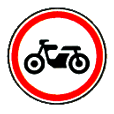 3.5 · No Motorcycles
Law: Art. 43 ¶16 Annex 1, sign 3.5
Overtaking a moped under sign 3.20. Overtaking any mechanical vehicle is prohibited in the zone of sign 3.20, except one moving at less than 30 km/h. You may overtake a motorcycle without a sidecar, a moped or a bicycle, as long as you do not move over to where oncoming traffic drives.
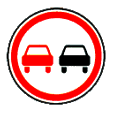 3.20 · No Overtaking
Law: Annex 1, sign 3.20
Mopeds: not on sidewalks or cycle paths. Riding a moped on the sidewalk is prohibited. The driver of a bicycle, for their part, is prohibited from riding on the carriageway outside a bicycle lane or bicycle path where there is one. A moped is a mechanical vehicle too, so riding it in bicycle lanes and on cycle paths is prohibited as well. More on this in the lesson on vehicle position on the road.
6 Cycle paths and columns
A cycle path crosses a road: the cyclist gives way. At an unregulated crossing of a bicycle path with a road away from an intersection, the bicycle rider must give way to drivers of vehicles on that road. Marking 1.15 marks the place where a bicycle path crosses the carriageway. It is not a pedestrian crossing, and the marking gives the cyclist no priority.
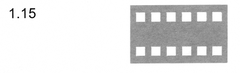 1.15 · Cycle Track Crossing
Law: Art. 43 ¶6 Annex 2, marking 1.15
Columns: up to 10 a group, 80–100 metres apart. Drivers of bicycles and mopeds are allowed to ride in columns. On the carriageway, a column must be split into groups of no more than 10. To make overtaking easier, the groups must be 80–100 metres apart.
Law: Art. 43 ¶4
Key points
- A driver takes special care with pedestrians, especially children, elderly people and persons with disabilities, and with cyclists. The driver gives way in all cases to a blind pedestrian with a white cane or a guide dog.
- Outside populated areas, on a two-way road with no dividing strip or sidewalk, pedestrians walk facing the traffic. People walking a bicycle, moped or motorcycle and people in wheelchairs keep to the right side of the carriageway. With no crossing or intersection in sight, the road is crossed at a right angle, only where there is no dividing strip or barrier and a clear view both ways.
- At an unregulated pedestrian crossing a driver slows down and, if necessary, stops and lets pedestrians cross. Where traffic is regulated, the driver turns towards a crossing at low speed and, if necessary, lets pedestrians cross, also on a green light. The driver enters a crossing only once sure of not having to stop on it.
- If a route vehicle stops or slows down before an unregulated crossing, or another stopped vehicle blocks the view, a driver goes on only once sure there is no pedestrian. Passing a route vehicle at a stopping place, the driver slows down and stops if necessary.
- A moped is not a motorcycle, but riding it in the zone of sign 3.5 is prohibited. Riding a moped on the sidewalk is prohibited too. A moped may be ridden from 16 years of age, a bicycle from 14 years.
- At an unregulated crossing of a cycle path with a road outside an intersection, the bicycle rider gives way. On the carriageway, a column of bicycles and mopeds is split into groups of no more than 10, 80–100 metres apart.
Plain-language summary for exam preparation; the law's text prevails.
Now answer this lesson's questions
29 exam questions are about this lesson. A wrong answer comes back until you get it right, and you see which questions are ready for the exam.
Practise the questionsFree account · sign in with e-mail or Google
The law behind this lesson
- Article 5. Terms Used in the Law
- Article 21. General Duties of a Driver / User of a Sliding Track
- Article 24. Requirements Related to Pedestrian Movement
- Article 22. General Requirements Related to Drovers
- Article 25. Rules of Behavior of a Driver towards Pedestrians and Certain Circumstances to be Considered by the Driver when Driving a Vehicle
- Article 43. Special Rules Related to Drivers of Bicycles, Two-wheeled Electric Scooters, Mopeds, Motorcycles, Snowmobiles and Motorsleds
29 exam questions
Practise the questions