
Question 118 · Category B, B1
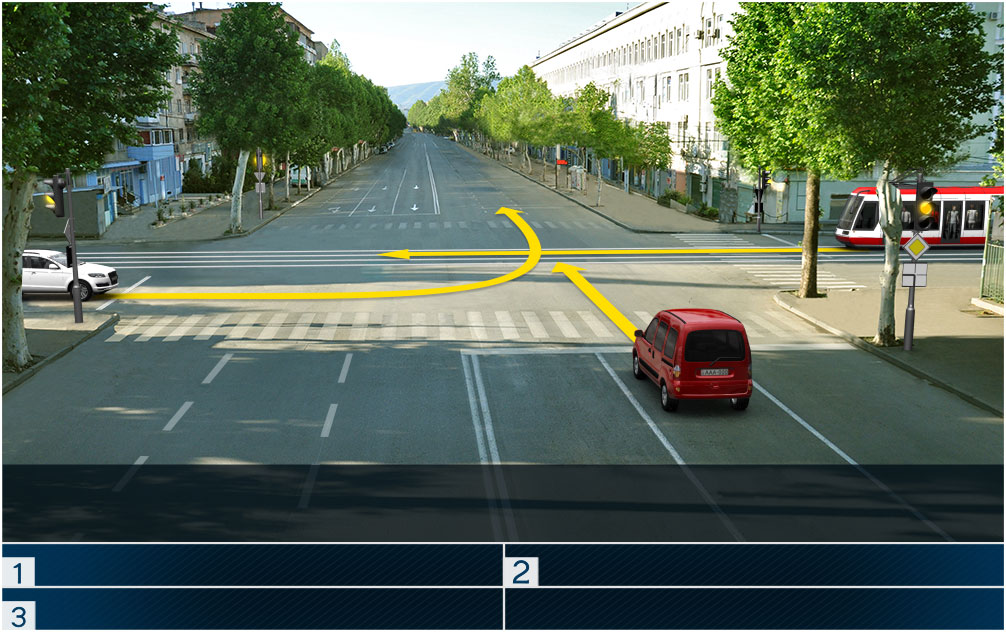
To which vehicle driver must the white car driver yield the right of way when moving in the direction of the arrow, if the traffic light has a flashing yellow signal?
Topic: 10. Traffic light signals
Answer options
- 1. Only to the tram driver
- 2. Only to the red car driver Correct answer
- 3. To both the tram driver and the red car driver
Explanation
Before the intersection, on the side from which the red car approaches, priority sign 2.1 "Main Road" is installed, and below it plate 8.13 "Direction of Main Road". The bold line on the plate enters from the bottom edge and turns to the left: this means the main road comes from the red car's side and continues onto the road along which the white car is approaching. Therefore the red car and the white car are both on the main road, while the road with the tram tracks, from which the tram is approaching, and the road into which the white car is turning left, are secondary.
According to subparagraph "d" of paragraph 2 of Article 29 of the Law of Georgia "On Road Traffic", a flashing yellow light signal permits movement and informs of the presence of an unregulated intersection, and according to paragraph 2 of Article 36 of the same law, if the flashing yellow signal is lit, the intersection is considered unregulated and the driver is obliged to be guided by the rules of passage through an unregulated intersection and by the priority signs installed at the intersection. In other words, the priority signs remain in force.
Under subparagraph "b" of paragraph 4 of Article 36, if the main road changes direction at the intersection, the drivers moving on this road must be guided between each other by the rules of passage of equal roads. So between the white car and the red car subparagraph "c" of paragraph 4 of Article 36 applies: the driver must give way to the vehicle approaching from the right. The white car enters the intersection moving from left to right, and the road along which the red car approaches meets the intersection exactly on the white car's right-hand side, so the white car must give way to the red car.
There is no obligation to give way to the tram: the tram is moving on the secondary road and, under subparagraph "a" of paragraph 4 of Article 36, must itself give way to a vehicle approaching from the main road, regardless of its further direction of movement.
The option "Only to the tram driver" is therefore wrong: the priority of a rail vehicle over a trackless vehicle is granted by subparagraph "c" of paragraph 4 of Article 36 only "at such an intersection", that is, at an intersection of equal roads, whereas here the tram's road is secondary in relation to the main road.
The option "To both the tram driver and the red car driver" is wrong for the same reason: the only vehicle that must be given way to is the red car. Subparagraph "d" of paragraph 4 of Article 36, which obliges a driver turning left to give way to an oncoming vehicle, covers only a vehicle moving on an equal road, and the tram is moving on a secondary road.
The course lesson on this topic: Intersections and giving way
Ready to test yourself?
Test yourself as in the exam: random questions from this same bank, against the clock. An account adds practice by topic, a review of your mistakes and your progress.
The simulation is free and needs no sign-up. Practice by topic needs a free account.