
Lesson 25 of 29 · Special places, people, vehicle, documents
Vehicle condition, hazard warning lights and identification signs
8 min 28 questions
Road safety depends on your vehicle as well. This lesson covers what a driver checks before setting off and which faults rule out driving. Then comes when to switch on the hazard warning lights and where to put the emergency stopping sign. A separate section covers the identification signs fixed to a vehicle.
1 Before setting off and on the way
4 4 exam questions on this sectionCheck before, keep it sound on the way. The driver must check the vehicle’s technical soundness before setting off and ensure it while driving. A check before the trip is not enough: the duty lasts the whole way.
Law: Art. 21 ¶12
If you hear a metallic noise and a characteristic squeal when braking, the brake pads are worn. Low tyre pressure can increase fuel consumption, make steering harder and overheat the tyres.
It is best to hold the steering wheel with both hands on the left and right sides of the rim, not at the bottom or the top. That way you can turn it quickly either way and bring it back, and your hands tire less.
2 When driving is prohibited
4 4 exam questions on this sectionService brakes, steering, hitch, wiper. A driver must not drive with a faulty service brake system, steering mechanism or, in a combination of vehicles, trailer hitch. If the wiper on the driver’s side does not work, driving a mechanical vehicle in fog, rain or snow is prohibited. Other faults are not part of this ban: a different rule covers them, set out below.
Law: Art. 21 ¶13
Headlights or rear clearance lights out in the dark. In the dark time of day a driver must not drive with both the dipped and high beam headlights failed or missing, or with the rear clearance lights out. This ban applies on a road without artificial lighting, and also where the road is visible for less than 300 m. By law this is insufficient visibility, including in the dark time of day. The English exam questions often say low beams for dipped beams and sidelights for clearance lights.
Law: Art. 21 ¶13 Art. 5 ¶7
Another safety fault: fix it, or move to a parking or repair place. If some other fault appears on the road that may affect traffic safety, the driver must fix it on the spot. If that is impossible, the driver must move the vehicle to a parking place or a repair place, taking every necessary precaution. The hazard warning lights must be on while doing so.
Law: Art. 21 ¶14 Art. 52 ¶1(e)
You are driving in the dark time of day along a street that street lamps light only in places, and your rear clearance lights go out. The road there is visible for less than 300 m, and that is insufficient visibility. So you do not drive on until the lights work again. The rule on fixing a fault on the spot or moving to a repair place covers other faults.
3 Hazard lights and the emergency stopping sign
7 7 exam questions on this sectionWhen the hazard lights go on. Hazard warning lights warn other road users of a possible danger; a driver involved in a road traffic accident must switch them on at once. They must go on if a vehicle in a road traffic accident, or a broken-down one, cannot be moved or towed away at once and obstructs others. They must also go on during a forced stop in a place where stopping is prohibited. The other cases are dazzle from oncoming traffic that forces the driver to stop, towing (on the towed vehicle), taking a broken-down vehicle for parking or repair, and other dangers.
Then the emergency stopping sign. After switching on the hazard lights, the driver must at once put out the emergency stopping sign, or a flashing red lamp in insufficient visibility. This duty applies at a road traffic accident and during a forced stop where stopping is prohibited. The sign must also go out where, given the visibility, other drivers could not notice the vehicle in time. If there are no hazard lights, or they are faulty, the sign must go out straight away.
Law: Art. 52 ¶2 ¶2(a) ¶2(b)
When they are not required. A forced stop does not create these duties by itself: what counts is the place, whether the vehicle obstructs anyone and whether it can be seen in time. If stopping is not prohibited there, nobody is obstructed and the vehicle is easy to see, the driver does not have to use the hazard lights or the sign. The exception is a forced stop when the headlights of an oncoming mechanical vehicle dazzle the driver: then the hazard lights must be switched on wherever the vehicle stands. More on where stopping is prohibited in the lesson on stopping and parking.
In a populated area your car breaks down at a three-way intersection with a solid marking line, and you stop at the right edge opposite the side exit. Stopping where carriageways cross, or closer than 5 m to their edges, is normally prohibited, but opposite the side exit of such an intersection it is allowed. Outside a populated area, in daylight, you stop off the carriageway where possible, for example on the shoulder. If visibility is good and you obstruct no one, neither the hazard lights nor the sign are required in either case.
It is different on a motorway and in a tunnel marked by a road sign. On a motorway, stopping is prohibited except in specially marked parking places, and a forced stop in a tunnel must meet the rules for places where stopping is prohibited. If your car breaks down there and cannot be moved away at once, you switch on the hazard lights and put out the emergency stopping sign: you need both. A motorway’s shoulder is part of the road too, so this applies even to a car that has stopped on the shoulder.
4 Where the sign goes: 15 and 30 metres
6 6 exam questions on this sectionThe emergency stopping sign 12 is an equilateral triangle with a red border and a hollow or light-coloured middle. Unlike the identification signs for studded tyres and for a learner vehicle, it carries no letter. The English exam questions often call it the emergency stop sign.
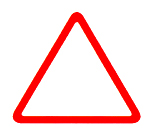 12 · Warning Triangle
Law: Art. 52 ¶5 Art. 19 ¶1(b) ¶1(h)
At least 15 m in a populated area, 30 m outside. The emergency stopping sign and the flashing red lamp must be placed at a distance from the vehicle that, in the actual conditions, warns other drivers in time. That distance must be at least 15 metres in a populated area and at least 30 metres outside one.
Law: Art. 52 ¶3
Your car breaks down on a motorway outside a populated area. You switch on the hazard lights and put the sign behind it, but less than 30 metres away. That breaks the rule: the sign is too close.
No sign: other means. If there is no emergency stopping sign or flashing red lamp, the driver must warn approaching drivers in time by other, similarly effective means.
Law: Art. 52 ¶4
5 Identification signs on vehicles
7 7 exam questions on this sectionSome identification signs are compulsory: the driver fixes them, or in cases the law defines, the enterprise. Others the driver fixes at will. Every sign is shown in Annex 3 to the law.
Law: Annex 3 Art. 19 ¶1 ¶2 ¶3 Art. 18 ¶1(d)
Studded tyres and a learner vehicle: different letters. The identification sign for studded tyres 2 must be fixed to the rear of a vehicle with studded tyres. The learner vehicle sign 6 must be fixed to the front and rear of a learner vehicle, and a two-sided sign may go on the roof of a passenger car. Both are white triangles pointing up with a red border, and they differ in the letter. The studded tyres sign carries the Georgian letter “k”, the learner sign the letter “s”.
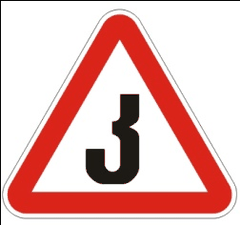 2 · Studded Tyres
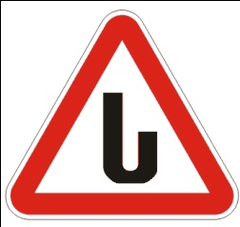 6 · Learner Vehicle
Law: Art. 19 ¶1 ¶1(b) ¶1(h)
Dangerous goods and a hearing-impaired driver. The identification sign for dangerous goods 5, an orange rectangle with a black border, must be fixed to the front and rear of a vehicle carrying dangerous goods. A tank carries it on its sides too. The hearing-impaired driver identification sign 4, a yellow circle with three black dots, must be fixed to the front and rear of a mechanical vehicle such a driver drives.
 5 · Dangerous Goods
 4 · Hearing-Impaired Driver
Law: Art. 19 ¶1 ¶1(c) ¶1(g)
Speed limit: at the rear, on the left. The identification sign for speed limits 7, a small colour image of road sign 3.24 with the permitted speed, must be fixed at the rear left of the body. It is required if the vehicle’s technical maximum speed is below the limit the law sets on sections signed for over 60 km/h and outside populated areas. It is also required on an oversized vehicle or one carrying dangerous goods, if its driver has under 2 years of experience as a driver. More on this in the lesson on speed.
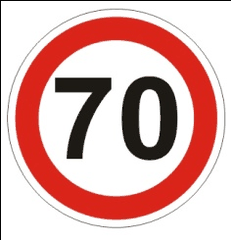 7 · Speed Limit
Law: Art. 19 ¶1 ¶1(i) Art. 33 ¶7
At the driver’s discretion. The driver may fix sign 10 to the front and rear of a mechanical vehicle driven by a person with a significantly or severely expressed disability status. It may also go on a vehicle carrying such a person. The exception is where the municipality has set its own identification sign and the persons entitled to receive it. The doctor sign 11 may be fixed to a vehicle driven by a doctor.
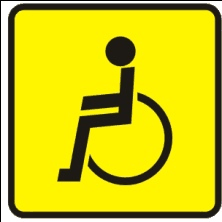 10 · Person with a Disability
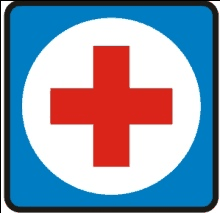 11 · Doctor
Law: Art. 19 ¶2 ¶2(a) ¶2(b)
Key points
- Soundness is checked before setting off and ensured on the way. Driving is prohibited with faulty service brakes, steering or trailer hitch, and with a dead driver-side wiper in fog, rain or snow. With dipped and high beams both out, or rear clearance lights out, driving in the dark is prohibited on an unlit road or in insufficient visibility.
- Any other fault that may affect safety is fixed on the spot. If that is impossible, the vehicle goes with its hazard lights on to a parking place or a repair place.
- A driver involved in a road traffic accident must at once switch on the hazard lights and then put out the emergency stopping sign. Both are needed during a forced stop where stopping is prohibited, for example in a tunnel or on a motorway. If stopping there is not prohibited, the car obstructs no one and is easy to see, they are not required.
- The emergency stopping sign, a red-bordered triangle with no letter, goes at least 15 metres from the vehicle in a populated area and at least 30 metres outside one. Without a sign, the driver warns approaching drivers by other, similarly effective means.
- The studded tyres sign goes at the rear, and the speed limit sign at the rear on the left. The learner vehicle, dangerous goods and hearing-impaired driver signs go at the front and rear. The signs for a person with a disability and for a doctor are at the driver’s discretion.
Plain-language summary for exam preparation; the law's text prevails.
Now answer this lesson's questions
28 exam questions are about this lesson. A wrong answer comes back until you get it right, and you see which questions are ready for the exam.
Practise the questionsFree account · sign in with e-mail or Google
The law behind this lesson
- Article 19. Identification Signs to be Affixed to a Vehicle
- Article 5. Terms Used in the Law
- Article 10. Main Requirements for Ensuring Road Traffic Safety during Vehicle Operation
- Article 11. Periodic Technical Inspection
- Article 11¹. Roadside Inspection
- Article 12. Prohibition of Vehicle Operation
- Article 21. General Duties of a Driver / User of a Sliding Track
- Article 52. Emergency Light Signalization and Emergency Stop Sign
- Article 53. Registration and Cancellation of Registration of a Vehicle, Its Numbered Aggregates and Auxiliary Technical Means of an Agricultural Machine
28 exam questions
Practise the questions