
Lesson 24 of 29 · Special places, people, vehicle, documents
Carrying passengers and children, cargo
6 min 16 questions
A child near the road can do the unexpected, and a child in a car rides by rules of its own. This lesson covers those rules, and where and how passengers may ride. It also covers how to load cargo, and how to mark cargo that sticks out with an identification sign.
1 A child near the road
4 4 exam questions on this sectionA child cannot read traffic like an adult. A driver must be aware that a child’s level of development does not let the child fully analyse road traffic conditions.
Law: Art. 26 ¶1
Special care. On seeing a child on or near the road, a driver must take special care. The same goes for a stopped bus bearing the identification sign 3. The driver must drive at a speed that avoids danger and, if necessary, allows stopping without sharp braking. A bus or a truck carrying a group of children must bear this sign at the front and at the rear.
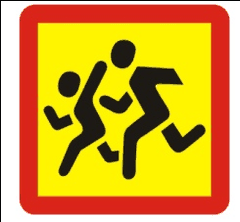 3 · Children on Board
Law: Art. 26 ¶2 ¶4 Art. 46 ¶7
You are approaching children playing ball on the sidewalk. The ball can roll onto the carriageway at any moment, and a child may run out after it with no thought for drivers. So slow down early and be ready to brake.
2 A child in the car
4 4 exam questions on this sectionSeated only. Children may be carried in a vehicle only seated, in seats provided by the vehicle’s design. Carrying children standing is prohibited. If the design provides no seats, carrying children standing is still prohibited.
Law: Art. 26 ¶3
Under 12 years: not in front, not on a motorcycle. Carrying a child under 12 years in the front seat of a passenger car, on a moped or on a motorcycle is prohibited. It is also prohibited on a small quadricycle with a design speed over 25 km/h, and on a motorized tricycle or quadricycle. For these three vehicles, the ban applies only if their design makes it impossible to use a special child cradle, seat or suitable holding device.
Law: Art. 26 ¶6 ¶6(a) ¶6(b) ¶6(c) ¶6(d)
Under 3 years: a child seat, or a lap in the back. A child under 3 years in the rear seat of a passenger car must ride in a special child cradle, seat or holding device matching the child’s height and weight. A child may also ride on the lap of a passenger aged at least 16 years sitting in the rear seat. That passenger must wear a seat belt, and one passenger must not hold more than one child. More on this in the lesson on the driver’s condition.
Law: Art. 26 ¶7 ¶8 Art. 21 ¶9
A driver carrying a child in a special child cradle, seat or holding device checks two things. First, that it matches the child’s height and weight. Second, that the vehicle’s design allows it to be used.
Law: Art. 26 ¶7 ¶6(c) ¶6(d)
Under 6 years: never left alone. Leaving a child under 6 years unattended in a stopped vehicle is prohibited. The age limit here is 6 years, not 12 as for the front seat. The English exam questions call such a vehicle a parked vehicle.
Law: Art. 26 ¶9 ¶6 ¶6(a)
The driver has stopped at a shop and wants to step out for a couple of minutes, with a five-year-old in the back seat. Leaving the child in the car unattended is prohibited, even briefly.
3 Where and how passengers ride
3 3 exam questions on this sectionNothing in the way of driving or the view. Carrying passengers in a number or a manner that hinders driving the vehicle or restricts the driver’s field of view is prohibited.
Law: Art. 46 ¶1
Not above the maximum permissible mass. Carrying passengers is prohibited when the vehicle’s actual mass exceeds its maximum permissible mass.
Law: Art. 46 ¶10 ¶10(c)
Not outside the cab or compartment. Carrying passengers outside the passenger compartment or cab of a motor vehicle, a tractor or another self-propelled machine is prohibited. The exception is carrying them in the body of a truck with a van body or a board platform. Carrying passengers on a truck trailer, in a trailer-cottage or in the body of a cargo motorcycle is prohibited too. The English exam questions call a trailer-cottage a mobile home, and the body of a cargo motorcycle a motorcycle basket.
Law: Art. 46 ¶10 ¶10(a)
The law calls the vehicle that tows the towing vehicle, and the one being towed the towed vehicle. When towing on a rigid or flexible coupling, the ban covers carrying passengers in a towed bus or trolleybus, or in the body of a towed truck. Passengers in the towing bus are not covered by this ban. More on this in the lesson on towing.
Law: Art. 45 ¶4 Art. 46 ¶10(a)
4 Cargo hampers nothing and hides no lights
2 2 exam questions on this sectionThe load endangers no one and does not hamper driving. Any cargo on a vehicle must be placed and, if necessary, secured so that it does not endanger other road users while it is carried. It must not damage state, public or private property, or drag or fall onto the road. It must not restrict the driver’s visibility or field of view, upset the vehicle’s stability or make it harder to drive.
Law: Art. 47 ¶11 ¶11(a) ¶11(b)
Lights and registration number stay visible. The cargo must not cover the vehicle’s lights, the stop signal, the turn indicators or the reflective devices. It must not cover the registration number, the distinguishing sign of the registering state or the hand signals either.
Law: Art. 47 ¶11 ¶11(c)
You are carrying bicycles on a rack at the back of a passenger car. They are firmly secured, but they cover the registration number and the stop signal. The load is placed wrongly: it has to be rearranged so that the number and the lights can be seen.
5 Overhanging cargo: 1 m and 0.4 m
3 3 exam questions on this sectionOver 1 m front or rear, over 0.4 m to the side. Cargo sticking out more than 1 metre beyond the vehicle’s dimensions at the front and/or rear must be marked with the identification sign 8. The same goes for cargo sticking out sideways more than 0.4 metres from the outer edge of the clearance light. The English exam questions call the clearance light the side light.
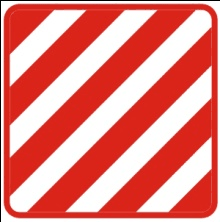 8 · Oversize Load
Law: Art. 47 ¶13
In the dark: white in front, red behind. In the dark time of day or in insufficient visibility, such cargo must also be marked. At the front it carries a white lamp or reflector, at the rear a red lamp or reflector.
Law: Art. 47 ¶13
You are carrying pipes in a truck’s body that stick out more than 1 metre beyond the vehicle’s dimensions at the rear, and it is already dark. The load needs the identification sign, plus a white lamp or reflector at the front and a red one at the rear.
Key points
- A child cannot fully analyse road traffic conditions. On seeing a child on or near the road, or a stopped bus with the identification sign for carrying children, the driver takes special care. The driver drives so as to allow stopping without sharp braking.
- Children ride only seated. Under 12 years: not in the front seat of a passenger car, not on a moped or motorcycle. Under 3 years: in a child seat matching height and weight, or on the lap of a passenger aged at least 16 years in the back.
- A child under 6 years must not be left unattended in a stopped vehicle.
- Passengers are not carried in a way that hinders driving or restricts the driver’s view. Nor are they carried outside the compartment or cab, except in the body of a truck with a van body or a board platform. They are not carried when the actual mass exceeds the maximum permissible mass either.
- Cargo endangers no one, does not hamper driving and does not cover the lights or registration number. Cargo sticking out over 1 m front or rear, or over 0.4 m to the side, carries the identification sign. In the dark or in insufficient visibility it also carries a lamp or reflector: white in front, red behind.
Plain-language summary for exam preparation; the law's text prevails.
Now answer this lesson's questions
16 exam questions are about this lesson. A wrong answer comes back until you get it right, and you see which questions are ready for the exam.
Practise the questionsFree account · sign in with e-mail or Google
The law behind this lesson
- Article 26. Additional Requirements for Ensuring the Safety of Children
- Article 5. Terms Used in the Law
- Article 47. Cargo of a Vehicle
- Article 21. General Duties of a Driver / User of a Sliding Track
- Article 46. Carriage of Passengers
- Article 46¹. Additional Requirements for Carriage of Passengers During Events – Excursions Organized/Arranged by Preschool Education and Upbringing Institutions or General Education Institutions
16 exam questions
Practise the questions