
Lesson 3 of 29 · Foundations
Traffic lights
10 min 57 questions
A traffic light decides who goes through an intersection and when. This lesson covers what each colour and arrow means, where the driver must stop, and what to do when the light, a traffic controller and road signs disagree. At the end: who goes first at a regulated intersection when green is lit for several directions at once.
In the law, a traffic light is an electrical device used to regulate road traffic on a road with coloured light signals. The types of traffic light are set out in an annex to the law, and this lesson shows their official drawings.
Law: Art. 5 ¶91 Annex 4
1 What each colour of a traffic light means
30 30 exam questions on this sectionVehicle traffic is regulated by a traffic light ტ.1 with three round signals: red, yellow and green. The English exam questions often call the yellow signal amber.
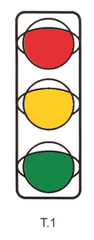 ტ.1 · T.1
Law: Art. 29 ¶3
Red and yellow mean stop. On a red or flashing red signal, movement is prohibited. Movement is prohibited on red and yellow lit together too: they announce that green is about to come on. A yellow signal also prohibits movement, except in the case described below, and announces that the signal is about to change.
Law: Art. 29 ¶2(a) ¶2(b) ¶2(c)
Green and flashing yellow mean go. On green you may go. Flashing green also allows movement, but warns that its time is running out and a prohibiting signal will soon come on. On flashing yellow you may go as well: it warns of an unregulated intersection, a crossing for pedestrians or cyclists, or a danger ahead.
Law: Art. 29 ¶2(e) ¶2(f) ¶2(d)
Where to stop. On a prohibiting signal of any traffic light except a reversible one, the driver must stop at the stop line (or road sign 7.16). The driver stops right at the line, not well short of it. Without one, the driver must stop at an intersection before the carriageway being crossed, without obstructing pedestrians, and at a railway crossing before the crossing. Elsewhere, the driver must stop before the traffic light or the controller, without obstructing vehicles and pedestrians whose way is open.
Law: Art. 29 ¶13 ¶13(a) ¶13(b) ¶13(c)
Yellow and sharp braking. A driver who cannot stop at these places without braking sharply when yellow comes on has the right to continue.
Law: Art. 29 ¶14 ¶2(c)
2 Arrows and extra sections
On the right ტ.1 მარჯ. or the left ტ.1 მარც. of a traffic light, at the level of the green signal, there may be an extra section with a green arrow. A contour arrow on the main green tells the driver that such a section may be there and shows the other permitted directions, apart from the section’s own. Arrows can also be shown on the coloured signals themselves ტ.2. Where a traffic light hangs above each lane, each light applies only to the lane it is above.
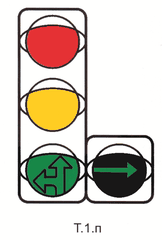 ტ.1 მარჯ. · T.1 right
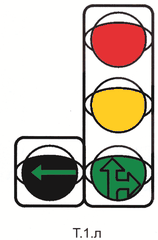 ტ.1 მარც. · T.1 left
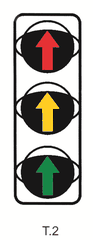 ტ.2 · T.2
Law: Art. 29 ¶1 ¶3 ¶10 ¶11
An arrow applies only in its direction. Green, yellow and red signals with an arrow mean the same as plain signals of that colour, but apply only in the direction of the arrow. On an arrow that allows a left turn, you may also make a U-turn, unless a road sign or road marking prohibits it. A green arrow in an extra section works the same way.
Law: Art. 29 ¶10
A dark extra section. If the signal of an extra section of a traffic light is switched off, movement in the direction that section regulates is prohibited. The main green does not let you go that way.
Law: Art. 29 ¶10
A dark section covers only the direction it regulates at that same intersection. Say a driver has gone straight through the intersection on the main green and turns right only after it, onto a road with no traffic light. The dark right section does not apply to that turn.
Law: Art. 29 ¶10
3 Traffic lights for special lanes and places
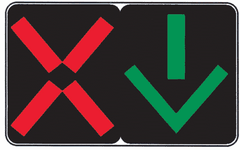
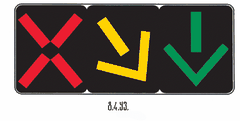
Reversible lights. Lanes where the direction of traffic changes to the opposite have a reversible traffic light ტ.4. Under its red X, movement in the lane is prohibited; under its green arrow pointing down, you may drive in it. A yellow or white arrow ტ.4 ყვ. slanting down to the right or left announces a change of signal: the driver must move to the lane it points to. If the reversible light above a lane marked on both sides with road marking 1.9 (the marking that bounds a reversible lane) is switched off, entering that lane is prohibited.
 ტ.4 · T.4
 ტ.4 ყვ. · T.4 amber
Law: Art. 29 ¶4 Annex 2, marking 1.9
On a reversible traffic light the X and the arrow sit side by side, but only the lit one counts. A dark X next to a lit green arrow does not close the lane.
Law: Art. 29 ¶4
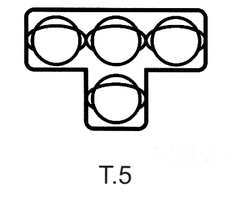
The T-shaped traffic light for route vehicles. A lane reserved for route vehicles (for example buses and trams carrying passengers on a set route) may be regulated by four round amber signals ტ.5 arranged in a T. Movement is permitted only when the lower signal and one or more upper ones are lit together. Of the upper ones, the left opens the way left, the middle straight on and the right to the right. If only the three upper signals are lit, movement is prohibited.
 ტ.5 · T.5
Law: Art. 29 ¶5 Art. 5 ¶67
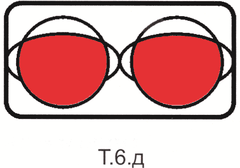
A special traffic light ტ.6 დამ. is used at railway crossings, at the approach to an opening bridge and at ship or ferry berths. It is also used at exits where fire service motor vehicles come out onto the road, and where aircraft fly low across the road. It has two alternately flashing red or yellow signals, or one flashing red or yellow signal, on one stand, at the same height and facing the same way. More on this in the lesson on railway crossings.
 ტ.6 დამ. · T.6 extra
Law: Art. 29 ¶8
Flashing red and flashing yellow. On red of such a traffic light, crossing the stop line is prohibited, and where there is none, passing the light. On yellow, drivers may carry on but must take special care. If the lights are off, movement is permitted only when no train (locomotive, draisine) approaching the crossing is in sight. At a railway crossing, a sound signal may come with the flashing red, telling road users once more that movement over the crossing is prohibited.
Law: Art. 29 ¶8 ¶9
At a crossing the red is flashing, but no train is in sight. The driver still may not go: the red forbids crossing the stop line for as long as it is lit. Once the flashing yellow comes on, the driver may carry on with special care.
4 Whose requirement prevails
5 5 exam questions on this sectionSometimes a traffic light, a controller, road signs and road markings in one place ask for different things. Where they contradict each other, the law sets out which one prevails.
Law: Art. 28 ¶2 ¶3 ¶4 ¶5
The controller first, but signs still apply. A traffic controller’s signals override traffic light signals, road signs, road markings and the road traffic rules. While a controller directs an intersection, the driver must still obey prohibitory and mandatory road signs, unless the controller specifically directs drivers to disregard them.
Law: Art. 28 ¶2
The controller points left. If the controller specifically points the driver to the left, the driver may turn left. Just as with an arrow that allows a left turn, a U-turn is then allowed as well, unless a road sign prohibits it.
Law: Art. 28 ¶2 Art. 29 ¶10
Lights override priority signs. Traffic light signals override the road signs and road markings that set priority. Road users must follow the traffic light even where it contradicts those signs and markings. While the light is working and not flashing yellow, its signals decide the order at the intersection, not which road is the main one.
Signs override markings. If road signs and road markings contradict each other, the driver must follow the road signs.
Law: Art. 28 ¶4
A temporary sign overrides a permanent one. A temporary road sign is one placed on a temporary portable stand or on the motor vehicle of a road works organisation. If it contradicts a sign permanently installed on the same section of road, the driver must follow the temporary sign. The temporary sign applies even where the permanent sign on the same section leaves more directions open.
Law: Art. 28 ¶5
When an intersection counts as unregulated. An intersection where the order of traffic is set by the signals of a traffic light or a controller is a regulated intersection. If a flashing yellow signal is on, or there is no traffic light or it is not working, or no controller is there, the intersection counts as unregulated. The driver must then follow the rules for unregulated intersections and the priority signs installed there. Drivers must follow the same rules when a controller’s signal lets trackless vehicles with crossing paths move at the same time.
Law: Art. 36 ¶2 ¶3(d)
So when a controller lets trackless vehicles with crossing paths go at the same time, the priority signs at the intersection decide the order again. More on this in the lesson on intersections.
Law: Art. 36 ¶3(d)
5 A regulated intersection: who goes first
22 22 exam questions on this sectionTurning left or U-turning on green. When turning left or making a U-turn on a green traffic light, the driver of a trackless vehicle must give way to oncoming vehicles going straight on or right. Tram drivers must follow the same rule among themselves. The English exam questions usually say yield for give way.
Law: Art. 36 ¶3(a)
In the diagram, the oncoming car is going straight on and faces a sign telling it to give way. But the traffic light is working, and its signals override priority signs. So it is the driver turning left who must give way.
An arrow lit with red or yellow. When following an arrow lit in the extra section of a traffic light with a main yellow or red signal, the driver must give way to vehicles from other directions. Such an arrow lets you go, but gives you no priority.
Law: Art. 36 ¶3(b)
Rail vehicles go first. If the signals of a traffic light or a controller let rail and trackless vehicles move at the same time, the rail vehicle has priority, whichever way it is going. But on an arrow lit in an extra section with a main yellow or red signal, the driver of the rail vehicle must give way to vehicles from another direction.
Law: Art. 36 ¶3(c)
The exception covers only vehicles moving “from another direction”. If a car and a tram come from the same direction and both follow such an arrow, the tram still has priority. And when a permitting signal without an arrow lets a tram and trackless vehicles go at the same time, the tram has priority too. Then the driver of a trackless vehicle crossing the tram tracks gives way to the tram, whichever way it is going.
Law: Art. 36 ¶3(c)
A prohibiting signal at the exit. A driver who entered the intersection on a permitting signal has the right to carry on in the intended direction despite prohibiting signals of the traffic lights at the exit. This is allowed as long as it does not obstruct other road users moving in the direction that is open. But if, on the way through the intersection, there are stop lines (or road signs 7.16) before the traffic lights, the driver must follow the signal of each light.
Law: Art. 36 ¶3(e)
Picture a wide road with a dividing strip down the middle. As the driver, you entered the intersection on green and are making a U-turn through the gap in the strip, where a second traffic light stands showing red. If there is a stop line in front of it, stop there. If not, finish the U-turn without getting in the way of traffic moving in the direction that is now open.
Let others finish crossing. When the permitting signal of a traffic light comes on, the driver must give way to vehicles still finishing their way through the intersection. The same goes for pedestrians who have not finished crossing the carriageway in that direction.
Law: Art. 36 ¶3(f)
Turning right behind a safety island. Sometimes the right-turn lane is separated from the rest of the carriageway by a raised safety island, and there is no traffic light on the right before the intersection. Then the right turn is made regardless of the traffic lights at the intersection. The driver must then give way to all vehicles coming from other directions.
Law: Art. 36 ¶3(g)
Key points
- Red, flashing red, yellow, and red with yellow prohibit movement; green, flashing green and flashing yellow allow it. When yellow comes on, you may carry on if you cannot stop at the stop line or the other set place without braking sharply.
- An arrow means the same as a signal of its colour, but only in its own direction. An arrow that allows a left turn also allows a U-turn, unless a sign or marking prohibits it. A dark extra section prohibits movement in the direction it regulates.
- At a railway crossing, flashing red forbids crossing the stop line, and flashing yellow lets you go on with special care.
- The controller overrides the traffic light, the light overrides the signs and markings that set priority, a road sign overrides road markings, and a temporary sign overrides a permanent one.
- Turning left or U-turning on green, you give way to oncoming vehicles going straight on or right; on an arrow lit with red or yellow, to vehicles from other directions. When a signal lets a tram and trackless vehicles go at the same time, the tram goes first.
- A driver who entered on a permitting signal may clear the intersection despite a prohibiting signal at the exit. This holds as long as the driver does not obstruct those whose direction is open and no stop line or sign 7.16 stands before the next light. And when a permitting signal comes on, the driver gives way to vehicles finishing their crossing and to pedestrians still crossing.
Plain-language summary for exam preparation; the law's text prevails.
Now answer this lesson's questions
57 exam questions are about this lesson. A wrong answer comes back until you get it right, and you see which questions are ready for the exam.
Practise the questionsFree account · sign in with e-mail or Google
The law behind this lesson
57 exam questions
Practise the questions