
Lesson 4 of 29 · Who directs traffic
Traffic controllers and their signals
7 min 28 questions
When a traffic controller stands at an intersection, a driver goes by the controller’s signals, not the traffic light. This lesson covers the controller’s four signals: what each of them allows and forbids to those approaching from each side. And what a controller’s gesture does not override.
A traffic controller is a person whom the law of Georgia empowers to regulate road traffic. Within their competence, a controller has the right to restrict a road user’s movement, change its direction or stop it. Road traffic is regulated by authorised persons of the Ministry of Internal Affairs of Georgia, and a driver must obey their lawful demands. Others may also regulate traffic within their legal powers, for example railway employees at railway crossings, rescuers during rescue work or the escort of a group of children.
1 The controller’s signals come before the traffic light
At once, whatever the traffic light shows. Road users must obey a traffic controller’s signals at once, even where they contradict the traffic lights, road signs, road markings or other road traffic rules.
Law: Art. 30 ¶4
The traffic light is green, but the traffic controller gives you, the driver, a signal that closes your way: you stop. And the other way round: on a red traffic light you drive on if the controller’s signal opens the way for you.
Prohibitory and mandatory signs still apply. While a traffic controller directs traffic at an intersection, a driver must still obey prohibitory and mandatory road signs, unless the controller specifically directs drivers to disregard them. So you do not drive in where a 3.1 sign stands, even if the controller’s gesture opens that direction.
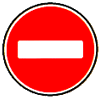 3.1 · No Entry
Law: Art. 28 ¶2 Annex 1, sign 3.1
Blue lights are no exception. The driver of an operational or special service vehicle, such as an ambulance, must obey a traffic controller’s signals too. This holds even with the blue flashing light and the sound signal on. If the gesture does not open that vehicle’s direction, it stops like everyone else. More on this in the lesson on special flashing lights and sound signals.
Law: Art. 30 ¶4 Art. 51 ¶1
2 One arm raised: “Attention, Stop” for everyone
3 3 exam questions on this section
Every driver stops. One arm raised means “Attention, Stop” for all road users, from every side. Drivers must stop, except those for whom stopping without sharp braking and with sufficient safety is no longer possible.
Law: Art. 30 ¶5(a)
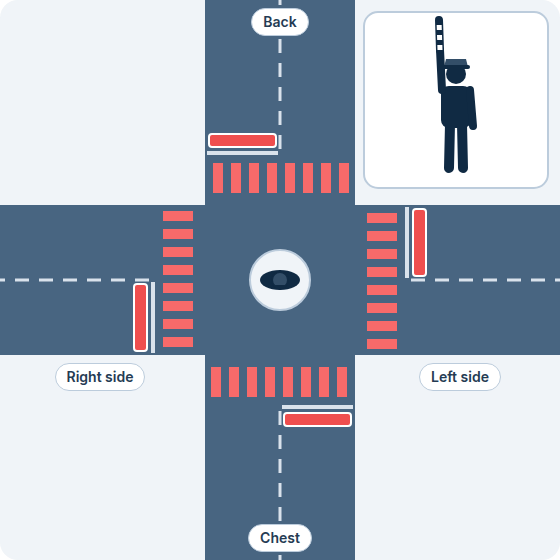
Already in the intersection. If this signal is given at an intersection, a driver who has already entered the intersection may continue.
Law: Art. 30 ¶5(a)
Pedestrians do not start crossing. For pedestrians this is “Attention, Stop” as well: they must not start crossing the carriageway, including at a pedestrian crossing. A pedestrian already on the carriageway when the signal is given must clear it or, if that is impossible, stop on the line dividing opposite flows of traffic.
Law: Art. 30 ¶5(a)
3 Arms out to the sides or lowered
7 7 exam questions on this sectionChest or back: stop. Arms stretched out to the sides or lowered mean “Stop” for road users whose path crosses the direction the controller’s arms indicate. These are the drivers approaching from the controller’s chest or back: they must stop, and no direction is open to them.
Law: Art. 30 ¶5(b)
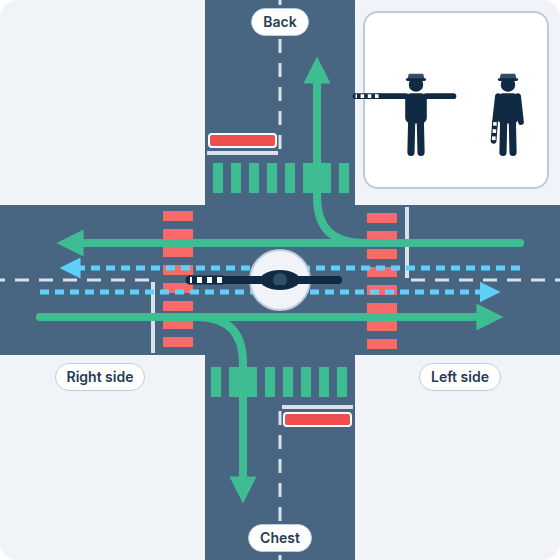
From the sides. From the controller’s right and left sides a tram may go straight on, and a trackless vehicle may go straight on or turn right. A pedestrian from those sides may cross the carriageway. Trackless vehicles are all vehicles that do not run on rails, for example passenger cars, buses, trucks and motorcycles. This gesture opens no left turn and no U-turn to anyone, not even from the sides.
Law: Art. 30 ¶5(b)
At a railway crossing a traffic controller closes the way for a driver by facing the driver chest-on or back-on. The controller also either raises a baton, a red lantern or a flag above the head, or stretches the arms out to the sides. If the controller faces you chest-on or back-on, lowered arms also mean “Stop”. If instead the controller stands side-on to you with arms lowered, you are approaching from the controller’s side, and the way straight on is open.
Law: Art. 39 ¶4 Art. 30 ¶5(b)
4 Right arm stretched forward
14 14 exam questions on this sectionThe outstretched right arm points the way the controller’s chest faces. If it points at the approaching driver, the driver is on the chest side; if it points away, on the back side. If, as the driver sees it, the arm points left, the driver is at the controller’s left side; if right, at the right side.
Law: Art. 30 ¶5(c)
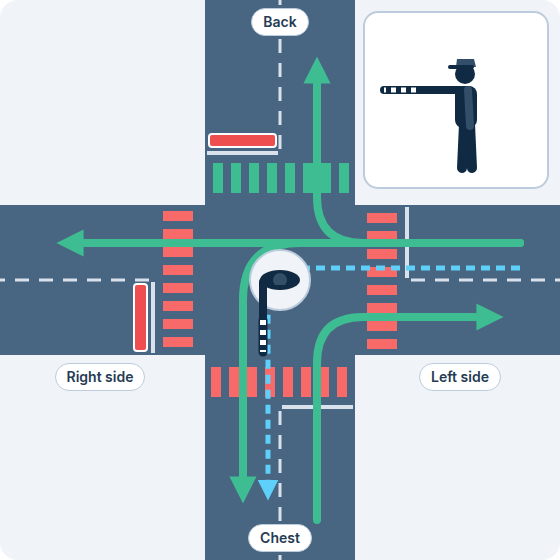
Right side and back: stop. A right arm stretched forward means “Stop” for all drivers approaching from the controller’s right side and back. They must stop, whichever way they mean to go.
Law: Art. 30 ¶5(c)
From the left side. From the controller’s left side a tram may go left only, while a trackless vehicle may go in all directions, including a U-turn.
Law: Art. 30 ¶5(c)
From the chest: right only. From the controller’s chest side every vehicle, trams included, may only turn right. Going straight on, turning left and making a U-turn are prohibited from that side.
Law: Art. 30 ¶5(c)
Pedestrians: behind the back. Pedestrians may cross the carriageway behind the controller’s back.
Law: Art. 30 ¶5(c)
A traffic controller at an intersection has the right arm stretched forward. The cars approaching from the controller’s back and right side wait. A car from the left side goes any way it needs, while a tram from there turns left only. A car from the chest side turns right only.
5 Other signals and the stopping place
4 4 exam questions on this sectionA moving red light: stop. A red light moved by a traffic controller means “Stop” for all road users it is directed at: they must stop.
Law: Art. 30 ¶5(d)
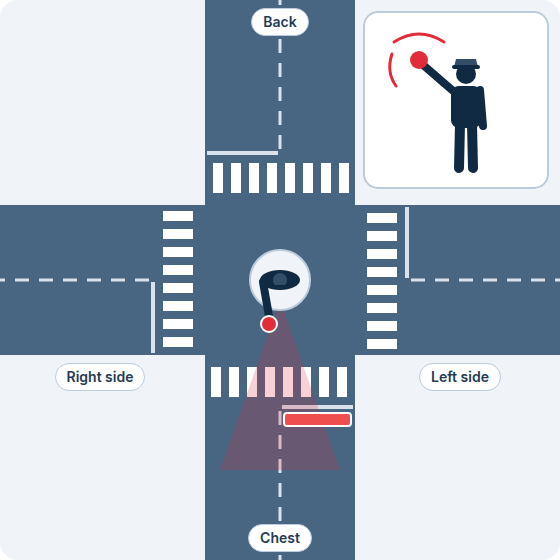
A traffic controller signals by hand, with a baton with black and white stripes or with a red reflective disc. Signals also come with a disc showing the road sign 3.2, a red or yellow flag, or a moving red light. An additional signal by whistle is meant to attract road users’ attention.
 3.2 · No Vehicles
Law: Art. 30 ¶9 ¶10 Annex 1, sign 3.2
Stop where the controller shows. If a traffic controller calls for stopping, through a loudspeaker or with a gesture towards the vehicle, the driver must stop at the place the controller indicates. The controller chooses the place, not the driver.
Law: Art. 30 ¶8
6 Turns only from the extreme position
Turn from the extreme position. A traffic controller’s gesture opens a direction, but it does not cancel the rule on the extreme position. Before turning right or left or making a U-turn, a vehicle’s driver must take the matching extreme position in good time on the carriageway for traffic in their direction. The exception is a turn made to enter an intersection with circular traffic. More on this in the lesson on turns and U-turns.
Law: Art. 32 ¶5
The traffic controller stands side-on to the car with arms lowered: from that side, straight on and right are open. But the driver is in the left of two lanes, with another free lane to the right, so the driver has not taken the extreme right position. That means no right turn; only straight on remains.
In the same way, a driver in the right-hand lane of two cannot turn left or make a U-turn, even when the gesture opens every direction. If there is only one lane in your direction, you already hold both extreme positions. Then you can turn or make a U-turn wherever the gesture opens the way.
Key points
- A traffic controller’s signals are obeyed at once, even against the traffic light, and blue lights are no exception. Prohibitory and mandatory signs at an intersection still apply unless the controller specifically directs drivers to disregard them.
- One arm raised is “Attention, Stop” for everyone. Only a driver already in the intersection, or one who can no longer stop without sharp braking, goes on.
- Arms out or lowered: stop from the chest and back. From the sides a tram goes straight on, a trackless vehicle straight on or right.
- Right arm forward: drivers from the right side and the back stop. From the left side a tram turns left only and other vehicles go in any direction; from the chest side everyone turns right only. Pedestrians cross behind the controller’s back.
- A moving red light means “Stop” for those it is directed at. An additional whistle signal is meant to attract attention. On a demand for stopping, a driver stops where the controller indicates.
- A gesture opens a direction, but you turn or make a U-turn only from the matching extreme position, except a turn into an intersection with circular traffic.
Plain-language summary for exam preparation; the law's text prevails.
Now answer this lesson's questions
28 exam questions are about this lesson. A wrong answer comes back until you get it right, and you see which questions are ready for the exam.
Practise the questionsFree account · sign in with e-mail or Google
The law behind this lesson
28 exam questions
Practise the questions